
NEWS
Tesla Burns AI Cash While SpaceX Sends the Invoices
Tesla launched Cybercab into a NHTSA audit while SpaceX, not Tesla, already bills Anthropic and Google for AI compute.

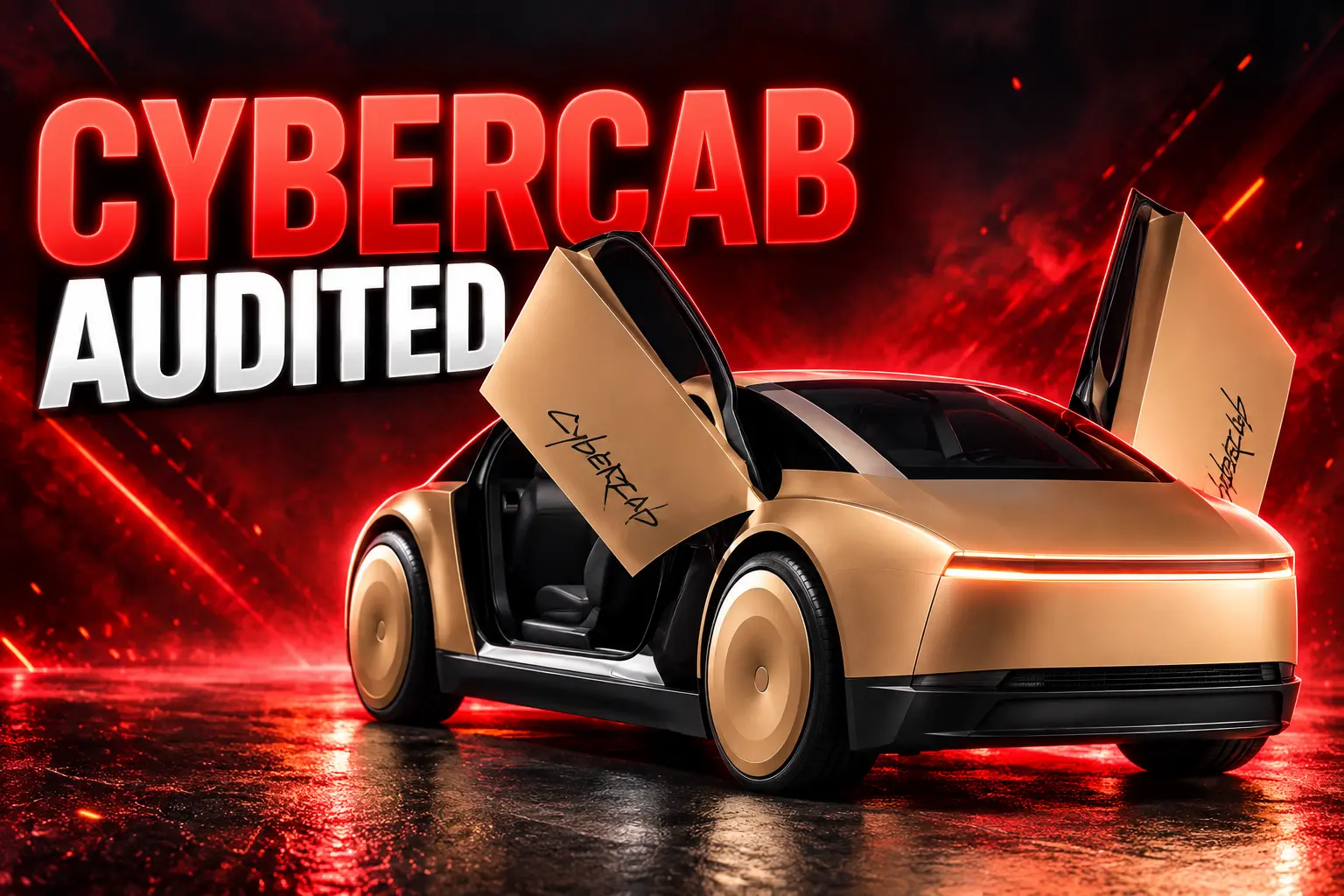
Tesla put paying riders in its two-seat Cybercab in Austin on September 3, and NHTSA opened an audit of the wheel-free car that day. The gold taxi has no steering wheel, pedals or mirrors. Shares fell 6% in the next session, to $354.08, leaving Tesla down 21% in 2026 and valued at $1.40 trillion.
Tesla still trades as Elon Musk’s public AI company. SpaceX, listed as SPCX after it absorbed xAI, is the Musk firm already collecting rent on Nvidia clusters from Anthropic and Google.
Cybercab Hits Austin and a Federal Audit
Tesla began production of Cybercab at Gigafactory Texas and, on September 3, opened paid rides in limited parts of Austin. Musk did not appear. There was no livestream and no published fare card or fleet target. GLJ Research’s Gordon Johnson kept a Sell rating and a $24.86 price target after the event, writing that Musk had promised a “storm of Cybercabs” and that what showed up included no pricing and a probe within a day.
The National Highway Traffic Safety Administration opened an Audit Query the same day, numbered AQ26002, covering an estimated 1,000 Cybercabs. The agency said Tesla had certified the vehicles as meeting all applicable Federal Motor Vehicle Safety Standards even though they lack a brake pedal, gas pedal, steering wheel and mirrors. NHTSA said it will review the technical data behind that sign-off, including whether Tesla treated some of those rules as not applying to a driverless car.
NHTSA fully supports the safe development and deployment of automated vehicles. But as the federal regulator, we need to ensure that all of our laws are followed.
Jonathan Morrison, NHTSA Administrator, agency statement
NHTSA also said it is rewriting several of those older rules, including ones on brake pedals, lighting and rearview mirrors, and that the current standards stay in force until that work is done. Texas records put 45 Cybercabs on the state register around the launch, a long way from the 1,000-vehicle population in the audit notice.
THE FIRST 48 HOURS
- September 3, 2026: Tesla starts paid Cybercab rides in limited Austin zones and holds a closed event without Musk.
- September 3, 2026: SpaceXAI reports a morning outage at its Memphis compute center, apologizes to Grok users and compute partners, then says systems are restored.
- September 4, 2026: NHTSA announces the Cybercab audit, and Tesla shares close at $354.08.
Tesla’s own Cybercab rider rules bar guests under 13 and allow ages 13 to 17 only with an adult. Model Y robotaxis still carry most of the service. Cybercab is the two-seat, camera-led car Tesla wants at the center of that network.
Anthropic and Google on the Colossus Lease
SpaceX closed its purchase of xAI on February 2, 2026, then listed on Nasdaq. The AI segment that came with that deal is not a side bet. In the second quarter it booked $2.56 billion of revenue, up 247% from $737 million a year earlier and up from $818 million in the first quarter, according to SpaceX second-quarter earnings tables.
Of that, $2.19 billion was AI solutions and infrastructure. SpaceX said new cloud agreements at Colossus and Colossus II added $1.6 billion of incremental infrastructure revenue in the quarter. Advertising on X added $367 million. The AI segment still posted a $1.26 billion operating loss, but adjusted EBITDA flipped positive at $1.15 billion as idle cluster capacity was rented out.
The tenants are not hypothetical. SpaceX’s IPO prospectus on compute deals described Colossus and Colossus II as about 1.0 gigawatt of compute at filing, with a Colossus II cluster of about 110,000 GB200 processors brought up in 91 days. Public filings around that listing set out the two large offtake contracts.
THE TWO ANCHOR COMPUTE LEASES
| Customer | Monthly bill | Window | Hardware named |
|---|---|---|---|
| Anthropic | $1.25 billion | Through May 2029 | Colossus capacity, 220,000-plus Nvidia GPUs |
| $920 million | October 2026 through June 2029 | About 110,000 Nvidia GPUs |
Once Google’s term is fully on, those two contracts imply $2.17 billion a month. Chief financial officer Bret Johnsen said SpaceX had another $6.7 billion of cloud services revenue under contract over a six-month stretch that starts ramping in October. Musk later said the company would build exclusively on Nvidia, citing the Vera Rubin design, and that nameplate compute was 1.4 gigawatts at the end of June, with a target above 2 gigawatts by year end.
Why Tesla’s Free Cash Flow Went Negative
Tesla’s car plant is still the cash engine. It is no longer covering the AI build. The Tesla Q2 shareholder update showed record second-quarter deliveries of 480,126 vehicles, up 25%, and revenue of $28.2 billion, up 26%. Trailing twelve-month revenue crossed $100 billion for the first time. Services and other revenue jumped 50% to $4.58 billion.
Operating income fell 57% to $398 million. The operating margin was 1.4%, down from 4.1%. Operating expenses rose 47% to $4.35 billion. Regulatory credits shrank to $146 million from $439 million. GAAP net income of $1.11 billion was cushioned by $590 million of other income. Operating cash flow was still healthy at $4.7 billion, up 85%. Capital spending of $5.8 billion, up 142% from $2.39 billion, flipped free cash flow to negative $1.1 billion, the first deficit since early 2024. Cash and investments ended at $43.5 billion, down $1.2 billion in the quarter.
TESLA Q2 CASH AND PROFIT
- Revenue: $28.2 billion, up 26% year over year, with 480,126 deliveries.
- Operating income: $398 million, a 57% drop, for a 1.4% operating margin.
- Capital spending: $5.8 billion, which turned $4.7 billion of operating cash into a $1.1 billion free-cash-flow hole.
- Liquidity: $43.5 billion of cash and short-term investments after a $1.2 billion quarterly decline.
Tesla’s June quarter 10-Q told investors to expect capital spending in excess of $25 billion in 2026, aimed at compute and data centers, factory ramps, and a larger fleet of company-run AI assets. The filing said the company intends to keep a strong balance sheet and that extra funding is possible. Active Full Self-Driving subscriptions rose 56% to 1.48 million, so the software attach rate is moving. It is not yet paying for the factories being stood up around it.
Fremont’s Model S Line Is Now a Robot Shop
The physical tell is in California. Tesla decommissioned Model S and Model X lines at Fremont and is installing first-generation Optimus lines on that floor, with production due later in 2026. Early robots are not for sale. They are headed to Optimus Academy for training data. A second Optimus site is under construction in Texas.
Tesla called this its “largest and most exciting period of investment.” The spend list in the July update is a map of a carmaker trying to become a robotics and chip shop while the car business still has to fund it.
WHAT THE 2026 BUILD IS BUYING
- Cybercab: Installed annual capacity above 125,000 at Gigafactory Texas, with production underway and paid Austin rides now limited in area.
- Optimus: First-generation lines at Fremont after the S and X teardown, plus a Texas building still going up, with early units used for training.
- Training clusters: Cortex 1 above 90 MW and Cortex 2 above 115 MW, both listed in production in Texas.
- Chips and cells: An Austin semiconductor fab in procurement, plus LFP, 4680, cathode and lithium work already in early ramp or production.
Robotaxi, as of the July update, was live in seven major U.S. metros, with unsupervised rides ramping in Texas and Florida and a safety-driver setup still in the Bay Area. That is a real service. It is also still mostly Model Y hardware, not the purpose-built two-seater that just met a federal audit on day one of paid use.
How Tesla’s Compute Compares With SpaceX
Tesla said it more than doubled onsite Texas compute, measured in megawatts, in the first half of 2026. Cortex 1 and Cortex 2 together are listed above 205 MW. SpaceX’s nameplate compute at the end of June was 1.4 gigawatts, up from 1.0 gigawatt in March and 0.4 gigawatts a year earlier. Tesla is training driving and robot models on clusters it owns. SpaceX is training Grok and renting leftover power to the labs that make Claude and Gemini.
TWO MUSK COMPANIES, TWO AI LEDGERS
| Q2 2026 | Tesla | SpaceX |
|---|---|---|
| Company revenue | $28.2 billion | $7.81 billion |
| AI-line revenue | Not broken out | $2.56 billion AI segment |
| Capital spending | $5.8 billion | $15.8 billion on AI |
| Cash result | Free cash flow -$1.1 billion | Net loss $541 million |
| Listed compute | Cortex 1 >90 MW, Cortex 2 >115 MW | 1.4 GW nameplate |
SpaceX spent $15.8 billion on AI capex in a single quarter, against Tesla’s entire $5.8 billion capital budget. SpaceX is still losing money at the company level. Connectivity, meaning Starlink, is the profit pool: $4.29 billion of revenue and $1.66 billion of operating income in the quarter. The AI segment is the growth line that turned adjusted EBITDA positive by leasing clusters that were built for Grok.
Musk has talked about Starmind, orbital data-center satellites, as a next step. That is a 2027 story. The 2026 story is simpler. One listing is selling GPU hours to frontier labs. The other is ripping out a luxury-car line to build humanoid robots that are not yet a product.
Two Public Stocks, One Chief Executive
For years the Tesla AI premium sat in one ticker because SpaceX was private. That structure broke in 2026. Tesla shareholders own Optimus lines, Cybercab tooling, Cortex and an Austin chip-fab plan. They do not own the Anthropic or Google compute contracts. Those sit at SPCX.
The two books still touch. Tesla is buying its own training power in Texas and designing inference chips for cars and robots. SpaceX is all-in on Nvidia for the Memphis clusters. A joint semiconductor project has been discussed around Tesla’s Austin fab, but Tesla’s own July update only confirms procurement for that plant. The invoices that already exist are SpaceX invoices.
Tesla’s multiple still prices a future in which unsupervised driving and humanoid labor throw off software-like profit. SpaceX’s AI print is smaller than Tesla’s car revenue and still unprofitable on a GAAP operating basis. It is, however, a contracted compute business with named counterparties and monthly rates. Tesla’s AI line is capex, headcount and a robotaxi app.
Grok’s Memphis Cluster Failed Its Tenants
On the morning Tesla put Cybercab on Austin streets, SpaceXAI said Grok went down after an outage at the Memphis compute center and apologized to “impacted compute partners.” Musk wrote that the company was taking corrective action so it would not happen again.
We are sorry for the issues you may have experienced with Grok following an outage at our Memphis compute center this morning. We’d also like to apologize to our impacted compute partners.
All systems have now been restored and are functioning nominally.
— SpaceXAI (@SpaceXAI) September 3, 2026
That apology is the tell Tesla does not have yet. SpaceX’s AI customers are labs that notice when a cluster trips. Tesla’s AI customers, on September 3, were riders in a geofenced two-seater and investors who had been told to wait for a storm of Cybercabs. The car business can still fund a lot of experiments. It funded a $1.1 billion cash hole in one quarter, and the first paid week of the purpose-built taxi opened with a federal audit. The compute rent is landing in a different ticker.
Disclaimer: This article is news reporting and analysis for information only. It is not investment advice, a recommendation to buy or sell Tesla, SpaceX or any other security, and it is not a prediction of future returns. Readers should consult a licensed financial adviser or other qualified professional who can review their own holdings, time horizon and risk tolerance before making any investment decision. Figures, ratings, contract terms and regulatory statuses are those published by the companies, NHTSA and the named analysts as of the dates cited and can change with later filings, audits or market moves.

Another IndiGo Radome Splits After a Normal Lucknow Landing

Apple Will Make Full Disk Access an Explicit Mac Grant

Chainalysis AI Traced the Bitget Hack in 10 Minutes

Yapily Sits Out Open Banking Deals After Turning a Profit

Google’s Gemini 4 Argon Goes to Cyber Defenders First

BMW’s Heated Seat Retreat Taught Automakers Which Fees Survive

Nashville Votes for a Dolly Parton Airport It Has Not Named

Copilot’s Election Problem Shifted From Errors to Silence

Tesla Burns AI Cash While SpaceX Sends the Invoices

The Book on China’s Car Brain Still Stars Infineon
-
 AUTO3 years ago
BMW’s Heated Seat Retreat Taught Automakers Which Fees Survive
-
 ENTERTAINMENT1 month ago
Nashville Votes for a Dolly Parton Airport It Has Not Named
-
 NEWS3 years ago
Copilot’s Election Problem Shifted From Errors to Silence
-
 NEWS1 month ago
The Book on China’s Car Brain Still Stars Infineon
-
 NEWS1 month ago
John Ternus Debuts a $2,099 Foldable and Holds iPhone 18
-

 ENTERTAINMENT2 months ago
Dolly Parton Laid to Rest as the Public Funeral Began
-

 TECHNOLOGY3 years ago
How to Find Saved Audio on Facebook?
-
 BUSINESS3 years ago
Mondelez Splits Château-Thierry Biscuits Between Nantes and Opava