
AUTO
Honda and Nissan Share Software-Defined Vehicle Computers After Setbacks
Honda and Nissan will share software-defined vehicle computers from fiscal 2029, after a failed merger and Honda’s cancelled 0 Series cars.

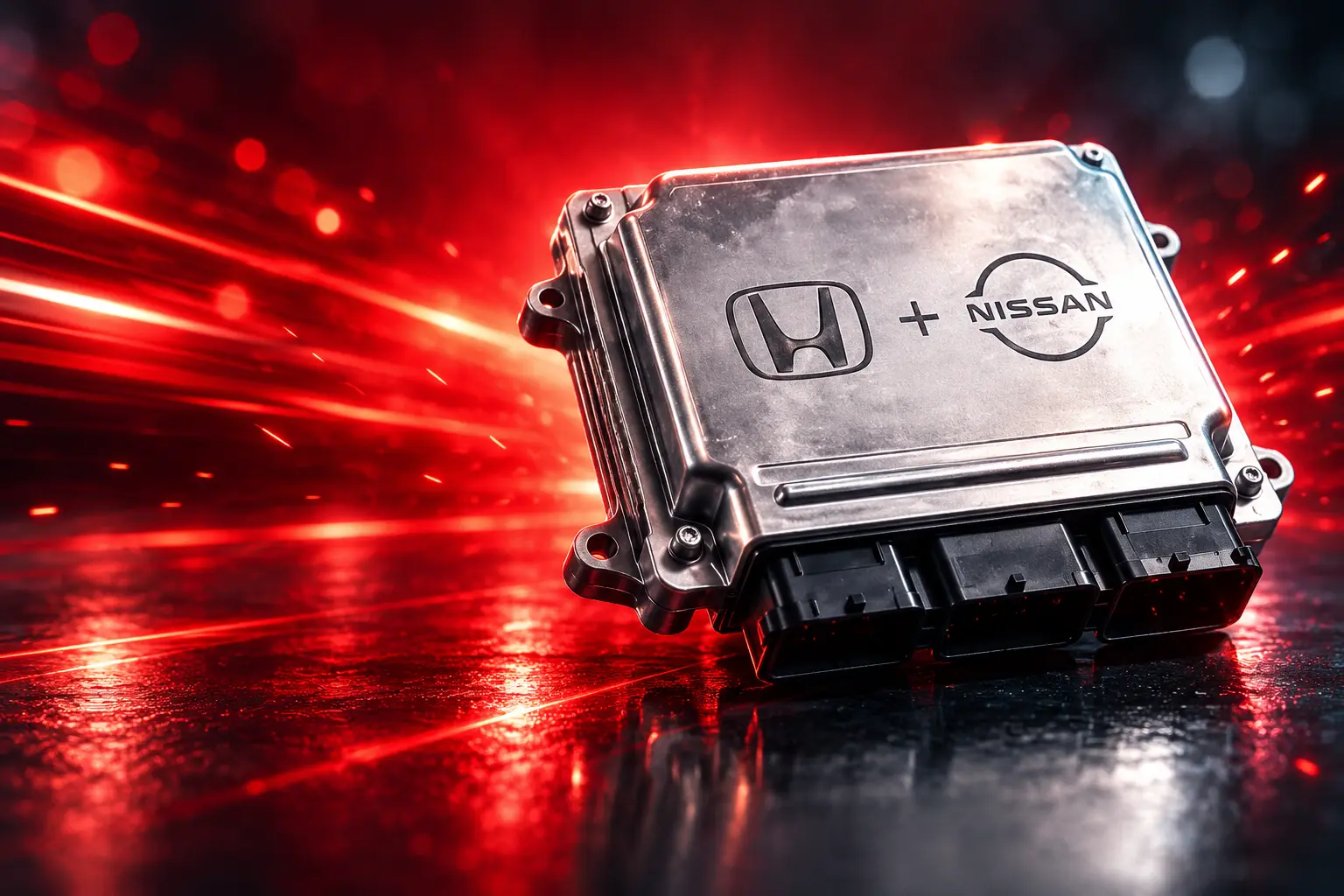
Honda and Nissan signed a joint development deal on August 31, 2026, to share core vehicle computers and software from fiscal 2029. The pact covers high-performance main ECUs, zone controllers, an in-vehicle operating system, and key parts of the middleware and vehicle-control code that runs on those boxes.
The two companies walked away from a full merger in February 2025, and Honda in March 2026 cancelled the electric cars that were meant to carry its own ASIMO OS.
A Shared Computer Stack for Honda and Nissan Cars
The notice from Honda Motor and Nissan Motor is narrower than a merger and more precise than a memorandum. The companies will standardize multiple electronic control units that form the core of next-generation software-defined vehicles, plus the in-vehicle operating system, key middleware, and vehicle-control software that run on those units. The electrical design that uses that shared kit is planned for both firms’ next software-defined vehicles from fiscal 2029, the Japanese year that starts in April 2029.
Honda’s footnote names the hardware. High-performance main ECUs, also called High Performance Computers, use systems-on-chip and act as the central computer. Zone ECUs oversee each area of the car, grouping wiring and control by place instead of by function. That is the kit both companies now say they will specify together.
WHAT THE AUGUST 31 DEAL STANDARDIZES
- Main computers: Common specs for SoC-based high-performance main ECUs that run as the vehicle’s central computer.
- Zone controllers: Common specs for zone ECUs that oversee each area of the vehicle.
- Vehicle OS: A shared in-vehicle operating system that runs on those controllers.
- Middleware: Key parts of the software layer between the OS and the apps.
- Control code: Key parts of the vehicle-control software that sits on the same boxes.
Honda told investors the joint development is not expected to have a material effect on consolidated results for the fiscal year ending March 31, 2027. The companies said they want faster cycles, shared engineering, and lower development cost through scale. They also said they will keep looking at other work under their strategic partnership, including carbon-neutral products and a goal of zero traffic deaths involving their vehicles.
That is a software contract, not a shared Civic or a shared Leaf. Body design, engines, factories, and dealer networks stay separate. People who read the headlines as a back-door merger are ahead of the paper the two firms actually signed.
After the February 2025 Merger Collapse
Honda and Nissan spent 2024 talking about a much larger combination, including a joint holding company, and formally pushed merger talks in December 2024. Those talks would have created one of the world’s largest automakers and pulled Mitsubishi Motors, in which Nissan already holds a stake, into the same orbit. The plan fell apart in February 2025 after Honda proposed making Nissan a subsidiary through a share exchange instead of pairing as equals under a holding company.
Nissan would not take that structure. Honda would not keep an equal-partner holding company when it wanted faster decisions. Both sides said at the time that they would keep working together on electric vehicles and other projects. The August 31 software contract is the first binding development agreement that has followed that breakup.
HOW THE TWO COMPANIES GOT TO A SHARED STACK
- January 2025: Honda shows ASIMO OS at CES as the original vehicle operating system for Honda 0 Series models then planned for 2026.
- February 2025: Honda-Nissan merger talks end after Honda proposes that Nissan become a subsidiary.
- March 12, 2026: Honda cancels the Honda 0 SUV, Honda 0 Saloon, and Acura RSX, the North American EVs that were supposed to run that OS.
- May 11, 2026: Nissan and Red Hat announce a joint engineering effort around a Linux foundation for Nissan’s next central vehicle computer.
- August 31, 2026: Honda and Nissan sign the joint development agreement to standardize core ECUs, the in-vehicle OS, middleware, and vehicle-control software.
- Fiscal 2029: First planned use of the shared electrical design in both companies’ next software-defined vehicles.
The 2024 research talks on next-generation software platforms did not disappear when the merger died. They also did not become a car company. What remains is the expensive layer both sides still cannot fund twice: the computers and the code that turn a finished car into something that can be updated after it leaves the plant.
What Honda Lost With the 0 Series
Honda decided on March 12, 2026, to cancel the development and market launch of three electric models planned for U.S. production, the Honda 0 SUV, Honda 0 Saloon, and Acura RSX, and it put the maximum total losses tied to its electrification reset at 2.5 trillion yen. Those were the cars Honda had built a new electrical design around, and they were the first vehicles named to run ASIMO OS.
Honda said U.S. EV demand had slowed, tariffs had hurt the profit of gasoline and hybrid models, and putting more people on EV work had weakened its cars in Asia. It also said Chinese buyers had moved their attention from hardware such as fuel use and cabin space to software features that keep changing after sale, including driver-assistance systems. Newer EV makers with short product cycles had taken that shift. Honda said it could not beat them on value.
In China, what customers value more in automobiles is shifting from hardware features, such as fuel efficiency and cabin space, to software-based features that will continuously advance according to customer preferences. This has intensified the competition due to the rapid emergence of newer EV manufacturers that leverage their short product development cycles and strengths in the area of software-defined vehicle (SDV) technologies, including advanced driver-assistance systems (ADAS). In such a difficult competitive environment, Honda was unable to deliver products that offer value for money better than that of newer EV manufacturers, resulting in a decline in competitiveness.
Honda Motor, March 12, 2026 statement
That paragraph is Honda describing the hole this August deal is trying to fill. The company had already spent years on an in-house vehicle OS named for ASIMO, the two-legged robot Honda introduced in 2000 after starting robotics work in 1986. Honda said it would install ASIMO OS for Honda 0 Series models as the core of automated driving, driver assistance, chassis control, and the digital cabin, with over-the-air updates after sale.
THE NORTH AMERICAN EVS HONDA PULLED
| Model | What it was for | March 12, 2026 decision |
|---|---|---|
| Honda 0 SUV | U.S.-built 0 Series EV | Development and launch cancelled |
| Honda 0 Saloon | U.S.-built 0 Series EV | Development and launch cancelled |
| Acura RSX | U.S.-built EV at Honda’s Ohio hub | Development and launch cancelled |
The August joint notice does not say whether the common OS will reuse ASIMO OS, start from Nissan’s stack, or write a third system. Honda still has a public technology page that treats ASIMO OS as the core of its software-defined cars, with a note that the text is current as of January 2025. The cars that page pointed to are the ones Honda later pulled.
Nissan Already Built a Linux Vehicle Stack
Nissan did not wait for Honda. On May 11, 2026, at Red Hat Summit, Red Hat said it was co-engineering Nissan’s next software-defined vehicle platform, including evaluation of the Red Hat In-Vehicle Operating System as a Linux foundation for Nissan’s Scalable Open Software Platform. Red Hat engineers were to be embedded in Nissan’s development pipeline. The in-vehicle OS is built on Red Hat Enterprise Linux and is meant to separate apps from the hardware so features can be updated while the car is still on the road.
Nissan is taking direct ownership of our software development lifecycle to better serve our customers in the mobility era. We work with Red Hat because they provide the technical depth required for a mission-critical platform that must remain on the road for decades. This joint engineering initiative for our next-generation Central Vehicle Computer gives us the agility to pivot and scale innovation across our global fleet.
Kazuma Sugimoto, general manager, SDV Software Platform Development Department, Nissan Motor, Red Hat Summit, May 11, 2026
Nissan’s own technology library, current as of June 2026, describes the Nissan Scalable Open Software Platform as a proprietary software-defined vehicle platform with three parts. Nissan Scalable Open OS is the in-vehicle system, with a vehicle API, Linux where updates are frequent, a real-time OS where fast startup matters, and AUTOSAR where the industry already standardizes. Nissan Scalable Open Data is a cloud store of vehicle data used to train AI. Nissan Scalable Open SDK is a cloud workshop with a virtual ECU so code can be built and tested away from a real car. Nissan says a central ECU lets software control the vehicle as one system.
That is a working description of the kind of stack Honda and Nissan have now agreed to specify in common. It is also a reminder that Nissan already picked a Linux vendor and a cloud toolchain months before Honda signed. The August contract says “common specifications.” It does not say Honda will run Red Hat, and it does not say Nissan will run ASIMO OS. Someone still has to choose the kernel both badges will ship.
Mitsubishi May Join the Same Controller Family
Mitsubishi Motors is not a party to the August 31 contract. It said it was considering joining the collaboration and was still talking with both companies about where it might fit. Nissan already holds a stake in Mitsubishi, and the three firms had been circling shared ECUs in the months before Honda and Nissan put a signature on paper.
A third badge on the same family of main computers and zone controllers would give suppliers a larger order book and give the two lead partners more volume to spread chip and software cost. It would not, by itself, give Mitsubishi a vote on the operating system. The joint development agreement is between Nissan and Honda. Any Mitsubishi role still has to be written.
Volkswagen’s path after years of trouble inside its own software group was to put money into Rivian and form a joint venture around Rivian’s stack, with separate China partners for the cars it sells there. Honda and Nissan are trying a cheaper version of that idea: keep the companies independent, share the computers and the OS, and spend the saved cash on hybrids, tariffs, and the next round of driver-assistance work. GM and Ford have said they will keep building their own software platforms. Honda and Nissan are no longer in that line.
A Fiscal 2029 Start for Shared Controllers
Fiscal 2029 is the first window Honda and Nissan will name for cars that use the shared electrical design. Tesla’s original Model S, the car most often cited as the start of over-the-air consumer vehicles, went on sale in 2012. Honda’s own 0 Series cars, with ASIMO OS, were supposed to reach North America in 2026 before the March cancel. The shared Honda-Nissan computers are therefore timed for a market that will already have had years of Tesla, Rivian, and Chinese software-defined models on the road.
Honda’s March statement already conceded that gap in China. The August deal is how two Japanese makers try to stop paying twice for the same catch-up. It is not a 2027 car, and it is not a patch for vehicles already in showrooms. Until fiscal 2029, each company keeps shipping whatever electrical design it already has, including Nissan’s current Leaf and Honda’s hybrid-heavy reset.
WHAT WE KNOW
- The contract: Honda and Nissan signed on August 31, 2026, to set common specs for core ECUs, an in-vehicle OS, key middleware, and vehicle-control software.
- The timing: The electrical design that uses that kit is planned for both companies’ next software-defined vehicles from fiscal 2029.
- The hardware: Honda names SoC-based high-performance main ECUs and zone ECUs as the units in scope.
WHAT IS UNCONFIRMED
- The OS name: The joint notice does not say whether the common system is ASIMO OS, Nissan’s Linux stack, or a new tree.
- Mitsubishi: Mitsubishi said it may join; it has not signed the development agreement.
- The first models: Neither company has named the Honda or Nissan vehicles that will launch on the shared controllers.
From here to April 2029, the work is specification, supplier selection, and the unglamorous job of making two safety cultures accept one computer. That is the part of this story that will decide whether the August paper is a stack or a press release.
How Much of the Car Stays Brand-Specific
Drivers will still meet a Honda cabin or a Nissan cabin. The deal standardizes the computers and a common operating system; each company can still write its own screens, apps, and driving-feel software on top of that shared layer, which is how most owners will judge the car. Honda and Nissan said they will keep building on their own strengths while they share the foundation.
In older cars, software was finished before production and lived on dozens of separate controllers that never changed. A software-defined vehicle collapses those boxes onto a few computers, adds a layer that lets apps talk to that hardware, and is built so the maker can fix bugs and add features over the air. Honda and Nissan are buying that structure together because each already learned, in public, what it costs to miss it. Honda wrote that lesson into its March 12 statement. Nissan hired a Linux company in May so it would not have to learn it alone.
The first Honda and Nissan cars on the shared controllers are still scheduled for fiscal 2029. Mitsubishi has not said whether it will pay into that stack. The August notice does not name ASIMO OS or Red Hat.

Another IndiGo Radome Splits After a Normal Lucknow Landing

Apple Will Make Full Disk Access an Explicit Mac Grant

Chainalysis AI Traced the Bitget Hack in 10 Minutes

Yapily Sits Out Open Banking Deals After Turning a Profit

Google’s Gemini 4 Argon Goes to Cyber Defenders First

BMW’s Heated Seat Retreat Taught Automakers Which Fees Survive

Nashville Votes for a Dolly Parton Airport It Has Not Named

Copilot’s Election Problem Shifted From Errors to Silence

Tesla Burns AI Cash While SpaceX Sends the Invoices

The Book on China’s Car Brain Still Stars Infineon
-
 AUTO3 years ago
BMW’s Heated Seat Retreat Taught Automakers Which Fees Survive
-
 ENTERTAINMENT1 month ago
Nashville Votes for a Dolly Parton Airport It Has Not Named
-
 NEWS2 months ago
Tesla Burns AI Cash While SpaceX Sends the Invoices
-
 NEWS3 years ago
Copilot’s Election Problem Shifted From Errors to Silence
-
 NEWS2 months ago
The Book on China’s Car Brain Still Stars Infineon
-
 NEWS2 months ago
John Ternus Debuts a $2,099 Foldable and Holds iPhone 18
-

 ENTERTAINMENT2 months ago
Dolly Parton Laid to Rest as the Public Funeral Began
-

 TECHNOLOGY3 years ago
How to Find Saved Audio on Facebook?