
NEWS
The Book on China’s Car Brain Still Stars Infineon
Gasgoo’s Building Cars 2.0 casts Infineon, Vector and SenseAuto as China’s automotive brain, even as homemade-chip cars fight the same stack.

A new Gasgoo book puts Infineon, Vector and SenseAuto at the center of the automotive brain, even as Chinese brands prepare cars with fully homemade chips. Zhou Xiaoying, CEO and editor-in-chief of Gasgoo, released Building Cars 2.0 in late August 2026 as the second volume of her New Auto, New Tech series.
The chapter on the “intelligent hub” asks who will define that brain. The three guests it picks sell chips, base software and cabin AI. They do not sell the driving SoCs Chinese carmakers are now designing for themselves.
Gasgoo’s New Book Hands the Car Brain to Suppliers
Building Cars 2.0 is a supply-chain book first. Its English subtitle is The Supply Chain Revolution Under Software-Defined Vehicles. Other chapters sit with Chery, Leapmotor, Changan and Deepal, and with interior and powertrain suppliers. The hub chapter is the one that treats the car as a computer.
Gasgoo has been pushing the volume one executive at a time. On September 5, 2026, its account posted a card on Dr. Matthias Traub, president of Vector Informatik, under the line “A New Paradigm for Software-Defined Vehicles.”
📕 New Book | #BuildingCars2.0 Now Available!
Featuring in-depth conversations with leading automotive executives worldwide.🔍Spotlight: Dr. Matthias Traub, President of #Vector
A New Paradigm for Software-Defined Vehicles👇Scan the QR code to learn more. #Gasgoo #CTalk pic.twitter.com/zNEip8pgEk
— Gasgoo Auto News (@Gasgoo_com) September 5, 2026
Cao Yanfei, Infineon’s senior vice president for automotive in Greater China, and Wang Xiaogang, CEO of SenseAuto, complete the trio. The copy around them is blunt: chips as the new engine, software as the skeleton, AI as the soul. That is a clean story. The product map underneath it is not.
Zhou has been making the wider claim all year. At a Stuttgart symposium on July 8, 2026, she said China’s industry had already moved into “AI-defined vehicles,” and that more than 60 percent of new cars now ship with advanced driver aids. High ADAS fitment is not the same thing as a homegrown central computer. The book’s three guests show where the floor still sits.
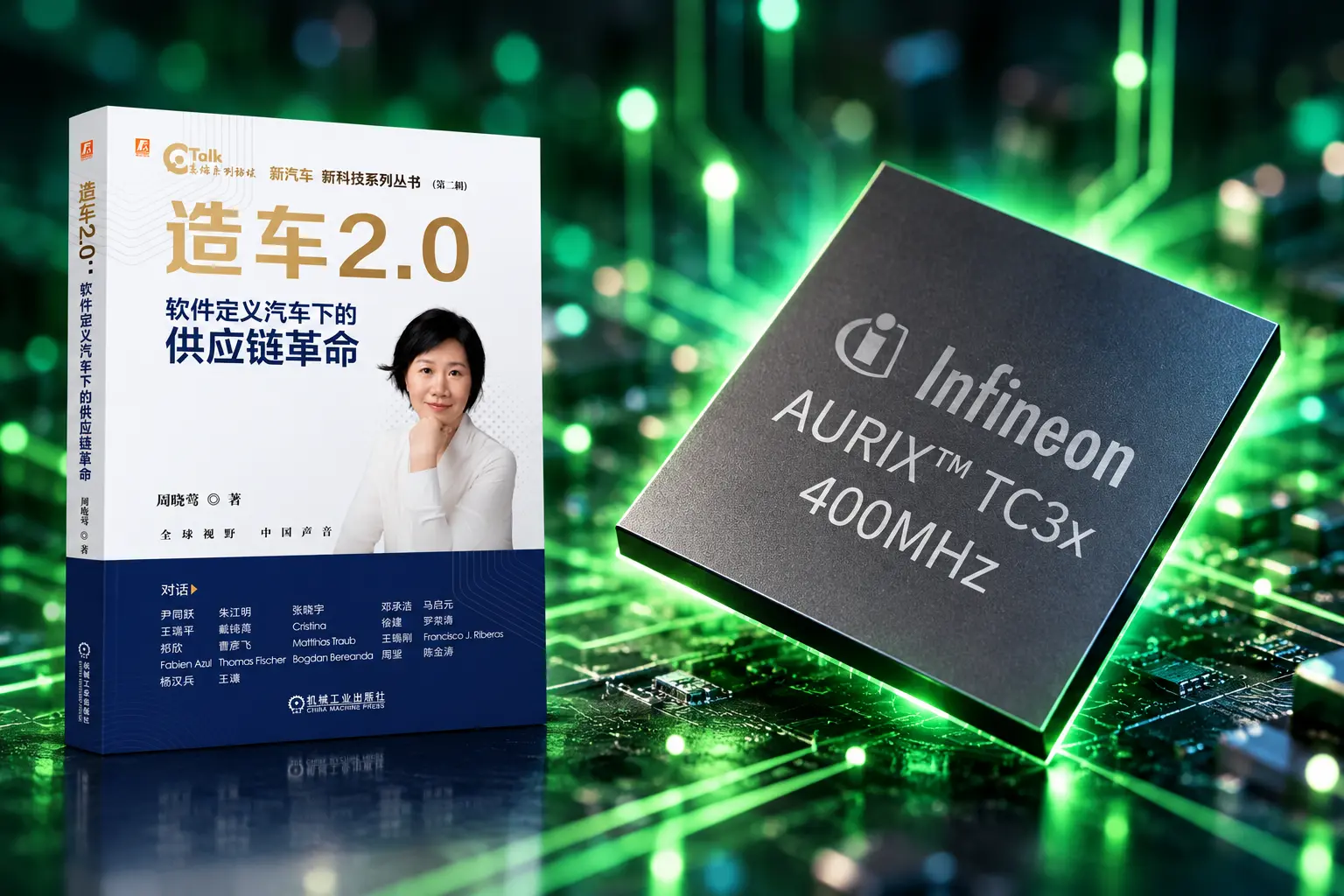
Infineon Is Moving AURIX Production Into China
Infineon is the German chipmaker that still owns the unglamorous layer every car needs before a large model ever loads: safety MCUs, power MOSFETs, radar silicon. Cao used an April 12, 2026 forum in Beijing to mark one year of the auto team’s China plan, which the company had set out in March 2025 as local product definition, local production and a local partner circle.
INFINEON’S 2025 SCOREBOARD
- MCU share: Infineon says it held 36 percent of automotive microcontrollers in 2025.
- Global auto chips: TechInsights put the market at $74.4 billion in 2025, with Infineon first at 12.8 percent for a sixth straight year.
- China weight: David Poon, president of Infineon Greater China, put China at 38 percent of fiscal 2025 sales, up from 34 percent.
- Group sales: Infineon reported about 14.7 billion euros in fiscal 2025.
Those figures explain the hurry. A company that takes more than a third of its sales from China cannot treat the country as an export bin. Cao’s update said Infineon now runs innovation centers with more than 10 leading carmakers and Tier-1s, and that it has been widening what it actually makes on the mainland since the second half of 2025.
INFINEON’S CHINA PRODUCTION CLOCK
- March 2025: Auto business in Greater China sets the three-pillar plan for local product definition, local production and local partners.
- Second half of 2025: Local output expands across MCUs, sensors and power devices, with some mass-production dates pulled forward.
- April 2026: Cao reports the first-year score, including 36 percent of automotive MCUs and a longer local lineup.
- 2026: 40V MOSFET SSO8 local mass production, moved up from 2027; Dual SSO8 devices from 40V to 100V already run in volume at Wuxi.
- 2027: Front-end and back-end production in China for 40-nanometer AURIX TC3x MCUs, and for 28-nanometer automotive radar sensors, with local wafer fabs and packaging plants.
Cao described the year as a move from a drawn plan into named projects. The AURIX TC3x work is the one that matters for anyone who still calls Infineon the car’s brain. That family is a safety MCU, the chip that has to boot, watch the other computers and fail in a defined way. It is not the 1,000-TOPS box that runs city driving. Infineon is also building a RISC-V automotive MCU line and, in 2025, bought Marvell’s automotive Ethernet business to sit closer to zonal networks.
The pressure on that plan is already in the market. In June 2025, people briefed on the work said SAIC, Changan, Great Wall, BYD, Li Auto and Geely were preparing models that use only homemade chips, with at least two brands aiming at mass production in 2026. Making AURIX in China keeps Infineon inside the supply chain. It does not make AURIX a Chinese design.
Vector Bets on a Pre-Built Software Floor
If Infineon wants the silicon that must never crash, Vector wants the software that sits on it. Traub joined Vector in 2023 and entered the managing board in October 2024 after electronics and software posts at Mercedes-Benz, BMW, Volkswagen and CARIAD. The Gasgoo interview sells Vector as the shop that can take “software-defined” from a slogan to a build that ships.
The product behind that pitch is not a cabin assistant. It is MICROSAR, PREEvision and a new joint stack with QNX. In January 2026 the two firms launched Alloy Kore, an Alloy Kore software foundation for automakers that pairs QNX’s safety-certified real-time OS with Vector middleware. Vector says the stack is built for ISO 26262 up to ASIL D and for ISO/SAE 21434, and that Mercedes-Benz is already looking at it for central computers.
Traub’s own warning is about process, not teraops. Carmakers still try to stitch operating systems, middleware and safety code on every program, then keep that private mix alive for a decade.
Our customers are investing significant time in integrating various components of a vehicle software platform and maintaining it throughout the vehicle’s lifecycle. By pre-integrating more parts upfront, we can drastically reduce the effort required by OEMs, ultimately shortening their time to market.
Matthias Traub, President and Managing Director, Vector Informatik
That is a German answer to a Chinese speed problem. Vector, QNX and TTTech Auto had already sold a pre-integrated vehicle software platform on the same logic: stop paying engineers to rebuild the floor. In April 2026 Vector also tightened its tie to NXP’s CoreRide zonal kit, bundling Microsar and Vector tools onto NXP silicon.
Chinese groups are making the opposite bet at the same time. Huawei, XPeng, NIO and others want the OS, the driving stack and the chip in one house. Vector’s offer only works if enough carmakers decide that the floor is not where they differentiate. The book treats that as a settled turn toward platforms. The live programs suggest it is still a fight.
Large Models Reach the Cabin Before the Road
SenseAuto is the Chinese name in the trio, the auto arm around SenseTime. Wang’s shop talks in AGI language. Its public architecture is a Driving, Cabin and Cloud design that treats the car as a place where models run, not only as a robot that steers.
DRIVING, CABIN, AND CLOUD
- Cabin: SenseAuto says its cabin AI software has ranked first in China for five straight years, built on driver and occupant monitoring plus large language and multimodal models.
- Driving: The company has put UniAD-style end-to-end stacks and a Drive AGI model on the price list, and in February 2026 it unveiled a generative driving system with Dongfeng.
- Cloud: Training, world models and fleet learning stay off the car, which is how SenseAuto argues that vehicles become a source of physical-world data once internet text runs dry.
By December 2023 SenseAuto said it had partnered with more than 30 automakers, covering more than 90 models and 1.95 million intelligent vehicles. Those are cabin-heavy numbers. The on-device pitch at Auto China 2026, Sage Box, leaned on “zero token cost” and always-on response, and SenseAuto has said that stack can run on chips from NVIDIA, Qualcomm and MediaTek.
That last clause is the one the hub chapter cannot wish away. A Chinese AGI cabin that boots on a Snapdragon or an Orin is still renting its brain. Wang has been clear that cars will feed the next wave of models with road data. He has been less clear that SenseAuto will own the SoC those models sit on.
Who Still Owns the Compute Inside Chinese Cars?
Call the central computer a brain and the argument on the ground is already about a different chip. Infineon’s 36 percent is an MCU figure. The driving computer fight in China now runs through Horizon Robotics, Huawei, Qualcomm’s cockpit-driving parts, NVIDIA where it can still sell, and a new round of carmaker-designed silicon.
Li Auto said its Mach M100 is a 5-nanometer driving chip at 1,280 TOPS. BYD has put its Xuanji A3 into production and said three of those chips deliver more than 2,100 TOPS. NIO has been shipping the 5-nanometer NX9031 since the ET9. XPeng is rolling its own Turing part. Those designs exist because US export rules made NVIDIA a political risk, and because city driving made bought 500-TOPS boards look tight.
The public fight that actually draws heat is that SoC layer. Horizon’s Journey line, its coming cockpit-driving Starry chip, and the in-house parts at NIO, Li Auto, BYD and XPeng are what people argue about when they argue about a Chinese car brain. Infineon’s AURIX does not trend in that thread. SenseAuto barely appears in it. Vector appears only if you already live in AUTOSAR.
That is not a slight on MCU physics. A car that cannot start its safety computer cannot run a 2,000-TOPS model. It does mean the book’s “brain” chapter is talking about the floor, the walls and the interior lighting, then using brain language for all three.
THE STACK THE BOOK ACTUALLY DESCRIBES
| Layer | Book guest | What they sell | Who else wants the slot |
|---|---|---|---|
| Safety MCUs and power | Infineon | AURIX, MOSFETs, radar | Homemade-chip programs at BYD, Geely, SAIC and peers |
| Base vehicle software | Vector | MICROSAR, Alloy Kore, tools | Huawei stacks and OEM in-house platforms |
| Cabin and driving AI | SenseAuto | Cabin models, Drive AGI, cloud training | Horizon, Qualcomm, NVIDIA, OEM models |
Read that way, the three interviews are not a single winner’s circle. They are a map of a stack that no longer has one owner. Infineon can localize Wuxi and still lose a socket to a Chinese MCU on a policy scorecard. Vector can ship Alloy Kore and still watch a carmaker keep the middleware. SenseAuto can win the cabin and still ride someone else’s SoC into the parking lot.
Three Layers, Three Different Owners
Building Cars 2.0 is useful because it writes down what suppliers will say when a Chinese editor asks them to define the next car. Infineon will say local production, local definition, local partners. Vector will say stop rebuilding the floor. SenseAuto will say the model should live in the cabin, the driving stack and the cloud at once.
None of that settles the question the chapter prints. Chinese brands are already trying to put 100 percent homemade chips into cars in 2026. Infineon’s AURIX TC3x is due to be made with Chinese fabs in 2027. Those two calendars are the whole story: the book’s chip wall-breaker is still racing to become local enough to stay, while the customers in the other chapters try to need it less.

Another IndiGo Radome Splits After a Normal Lucknow Landing

Apple Will Make Full Disk Access an Explicit Mac Grant

Chainalysis AI Traced the Bitget Hack in 10 Minutes

Yapily Sits Out Open Banking Deals After Turning a Profit

Google’s Gemini 4 Argon Goes to Cyber Defenders First

BMW’s Heated Seat Retreat Taught Automakers Which Fees Survive

Nashville Votes for a Dolly Parton Airport It Has Not Named

Copilot’s Election Problem Shifted From Errors to Silence

Tesla Burns AI Cash While SpaceX Sends the Invoices

John Ternus Debuts a $2,099 Foldable and Holds iPhone 18
-
 AUTO3 years ago
BMW’s Heated Seat Retreat Taught Automakers Which Fees Survive
-
 ENTERTAINMENT1 month ago
Nashville Votes for a Dolly Parton Airport It Has Not Named
-
 NEWS3 years ago
Copilot’s Election Problem Shifted From Errors to Silence
-
 NEWS1 month ago
Tesla Burns AI Cash While SpaceX Sends the Invoices
-
 NEWS1 month ago
John Ternus Debuts a $2,099 Foldable and Holds iPhone 18
-

 ENTERTAINMENT2 months ago
Dolly Parton Laid to Rest as the Public Funeral Began
-

 TECHNOLOGY3 years ago
How to Find Saved Audio on Facebook?
-

 BUSINESS3 years ago
Mondelez Splits Château-Thierry Biscuits Between Nantes and Opava