
LIFESTYLE
How to Make a Long Skirt Shorter Temporarily: A No-Sew Guide
Learn how to make a long skirt shorter temporarily with pins, a knot, a belt, or fashion tape, and leave iron-on hem tape for the length you plan to keep.

A long skirt that pools over your shoes can be shorter before you leave, and you do not have to cut it. How to make a long skirt shorter temporarily is a question of where you hide the extra cloth and what holds it there. Pins, a rolled waist, a belt, a side knot, and double-sided fashion tape lift the hem for the night and come off again. Iron-on hem tape and fabric glue are a different job, because they are meant to stay through the wash.
Match the hold to three things: how much length you need to lose, whether the cloth can take a pin or a sticky strip, and whether the original hem has to look untouched tomorrow. A pin that disappears in denim will leave a hole in satin, and a knot that saves a full maxi has nothing to grab on a pencil skirt. The pages ahead sort the holds that release, the two bonds that stay, and a last check you do in the shoes you will actually wear.
What Changes When You Shorten a Skirt for One Night?
You can take length from the hem or from the waist, and those two moves treat the skirt you already own in different ways. Folding the hem to the inside lifts the edge and hides the original finish under the new line. Rolling or tucking the waist lifts the whole skirt, so lace, embroidery, or a high-low edge stays where it was sewn.
Neither move needs scissors. A sewn hem is the lasting version of the same fold: a hand slip stitch that barely shows on the outside, or a machine hem made with a double fold about a half inch deep. Hem tape and fabric glue copy that folded hem without a needle, and they are built for wearing and washing. Save them for the day you have tried the length and decided to keep it.
Which Skirt Shortening Method Fits Your Plans?
Pick the hold before you pick up a pin. The rows below are a decision, and the last two are alterations that only look quick.
| Method | How it comes off | Use it when | Leave it when |
|---|---|---|---|
| Inside safety pins | Open the pins | Woven cotton or denim, one night, or a length you are still testing | Satin, silk, or chiffon, where a pin hole stays |
| Rolled waistband | Unroll and remove the pins | The hem has lace or stitching you want to keep, and the waist is soft enough to fold | A stiff waistband, a zipper you would crush, or a skirt with no extra room at the waist |
| Belt | Unbuckle it | A loose maxi or full skirt, when you only need a small lift | A fitted pencil skirt with no spare cloth above the waist |
| Side knot or hair tie | Untie it | A casual full skirt that is dragging, including at one side | A tailored skirt, or a formal cloth you do not want creased |
| Double-sided fashion tape | Peel it off | One evening, and a smooth fold on cloth that is not sheer | Sheer cloth, silk that marks, or heavy denim the tape cannot support |
| Iron-on hem tape | Sold as a washable bond | The length is decided and the care label allows a medium iron | A borrowed skirt, a one-night plan, or cloth that cannot take heat |
| Fabric glue | It sets into a lasting bond | Cloth that cannot take an iron, once you have decided to keep the length | Any skirt you may want at the old length |
Picture a cotton maxi, flats that let the hem touch the floor, and a dinner where you will sit. Pins inside the hem match that plan: the weave hides them, you open them at home, and you learn whether that ankle length is the one you later want sewn. The same dinner in a borrowed satin skirt changes the pick. Pins mark satin, so a loose belt, if the skirt has cloth to pull up, or a side knot, if the cut is full, keeps the cloth clean for the person you return it to.
How to Pin up a Long Skirt From the Inside
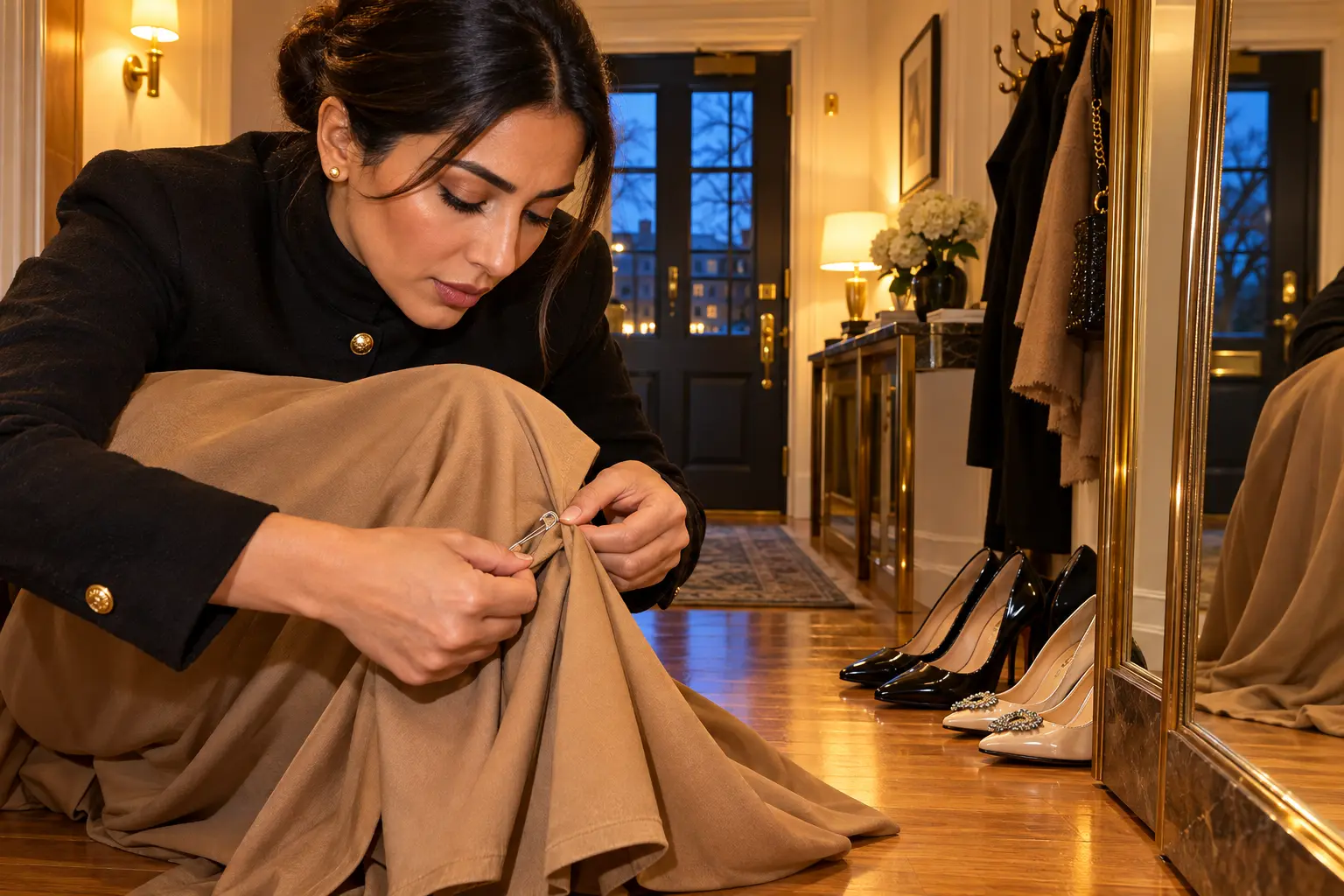
Safety pins are the hold for the next few minutes, on cloth that can take a small hole. They test a length and they get you out the door. They are not a hem you forget for a month.
- Put the skirt on with the shoes you will wear, then fold the extra length to the inside until the hem clears the ground the way you want. A mirror, or a friend, keeps the line even, because bending to pin your own hem shifts it.
- Take the skirt off. If the care label allows an iron, press the new fold so the edge stays level. Skip the iron when the label says not to use one.
- Work on the inside. Pin the folded hem at both side seams first, then at the center front and the center back, so the front cannot drop when you sit. Slide each pin through the outer cloth and the folded layer, and close it where you cannot see it. Thick cotton and denim can hide the whole pin in the fold. Thin cloth can still show a small glint of metal.
- Where the fold gaps between those four pins, add more, set sideways along the fold so a stride does not catch the clasp. A waistband roll uses a vertical pin instead, which is a different job.
- Walk, sit, and turn. Move any pin that puckers the outside or scratches your leg.
Clothes Doctor publishes a skirt turn-up pinning guide for clothes heading to a tailor, and the same first move applies at home: tuck the extra cloth inside and pin where you want the skirt to end. This short clip shows that turn-up.
One pin is enough to judge a length. It is not enough to wear through a dinner. If you are still deciding whether to cut, spend the evening in the pins before any scissors come out, and leave a fold’s worth of cloth below the line you like so a later hem has something to turn.
How to Roll a Skirt Waistband and Keep the Hem
Rolling the waist is the method that protects a hem you like. The length comes off the top, and the edge that was dragging stays the finished edge.
- Stand in the skirt and the shoes, in front of a mirror, and decide where you want that finished edge to sit.
- Fold the waistband inward, toward the inside of the skirt, then fold again until the hem is where you chose. Smooth each turn so you are not pressing a wrinkle into the waist.
- Pin vertically through the stacked layers. A vertical pin is harder to slide out of a roll. Hide the pins inside the folds. A thick waistband can take more than one pin, and double-sided fabric tape can stand in for the pins when the tape suits that cloth.
- Put the skirt back on. If it slips down your hips, the roll used up the ease that was holding it at your waist. Let out one turn.
A tuck is the cousin of the roll, and it suits a fitted waistband with spare cloth below it. Gather that spare cloth and push it up inside the waistband so the hem rises and the waist looks a little layered. It will not cling the way a sewn hem does, so sit in it before you commit to the night. A stiff denim waistband, or one with a zipper you would have to crush, is a sign to pin the hem instead.
How a Belt or a Side Knot Shortens a Skirt
Blouse the Skirt Over a Belt
A belt shortens a loose skirt by moving spare cloth up, not by making a new edge. It needs a flowing maxi or a full skirt. A pencil skirt with nothing above the waist to spare will only change shape.
- Fasten the belt a little looser than you normally would.
- Tug the skirt upward so a soft puff of cloth rests on top of the belt and the hem climbs.
- Check the floor, not only the waist in the mirror. On a loose maxi, that pull is worth a couple of inches.
A wide belt or a waist cincher gives the puff somewhere to sit. Higher on the waist reads more fitted, and lower on the hips reads looser. The hem only rises by the cloth you actually pulled through the belt.
Knot or Tie the Extra Skirt Fabric
A knot belongs on a full skirt you are happy to look casual in. Pick a spot at the side of the hem, at the thigh, or near the hip. Gather a tube of spare cloth in one hand, wrap that tube over and under itself into a simple knot, and slide the knot until the hem clears. A hair tie is the neater version of the same gather: bunch the cloth near the hip and cinch it so you are not relying on a bulky knot in a slippery weave.
This is the maxi fix that leaves the waistband alone and leaves no holes. It also creases the handful you tied, and it cannot shorten a skirt that is already fitted from waist to hem, because there is no tube of cloth to grab. Sit once before you leave. If the knot pulls a side seam open, retie it lower or switch to pins on a cotton skirt.
How Does Iron-On Hem Tape Work on a Skirt?
Hem tape looks like the tidy answer, and on the right day it is. That day is the one when you already know the length and you are willing to keep it. The HeatnBond hem tape press steps describe a permanent, heat-activated bond. These are the rules on that sheet.
| Step | What the sheet specifies |
|---|---|
| Before you start | Pre-wash without fabric softener, and test the adhesive on a hidden spot |
| Iron | Medium heat, steam off |
| On the fold | 3 to 5 seconds in each spot, with the iron on the cloth only |
| Right side | 1 to 3 more seconds after you turn the skirt out |
| Lighter cloth | Regular weight, for cotton and linen |
| Heavier cloth | Super weight, for denim and corduroy |
| Washing | Delicate cold wash, low tumble dry, no dry cleaning |
Do not set the iron on the bare tape. The adhesive melts onto the iron and the board, which is why the tape has to sit inside the fold before any heat. ThermOWeb’s hem tape demo shows that same sandwich, tape between two layers of cloth. Peeling a fused strip off later is how a hem gets shiny or stiff, so a borrowed skirt and a length you are still testing stay with pins or fashion tape.
Double-sided fashion tape, the kind sold to hold a neckline or a temporary fold, matches a one-night plan. Clean and dry the spot, mark the length, and press the tape inside the fold, short of the edge so it cannot peek out. Sheer cloth shows the strip as a darker line. Heavy denim can beat the stick. Peel it off before the skirt sees a washing machine.
Fabric glue sits with the lasting methods. Spread a thin line inside the fold, with wax paper or a bag between the layers so the front cannot glue itself to the back, and give it 24 hours before you wash. A thick bead goes stiff and can show on the outside. Glue is the route when the cloth cannot take an iron and the new length is already decided. Skip duct tape: it holds a fold for a short time and can leave a sticky film on the cloth.
Skirt Fabrics and Shapes That Change the Method
Satin, Silk, and Sheer Skirts
FABRICS THAT KEEP A MARK
- Pin holes: A safety pin will leave a hole in satin, so test one pin inside a seam and stop if you can already see it.
- Heat and glue: A medium iron, hem tape, or fabric glue can leave a shine or a stiff strip on silk, so keep them off a skirt you have to return.
When the cut allows it, a belt or a knot keeps satin and silk free of holes and sticky strips. Sheer chiffon shows tape and glue as a line through the cloth. On a formal borrowed skirt with no spare cloth to knot, leaving the length alone is safer than a bond you cannot undo before you hand it back.
Cotton and Denim Skirts
Cotton and denim are the easy case for a one-night pin, because the weave hides a small pin more kindly than satin does. Try one pin at a side seam before you commit to a ring of them. A heavy denim hem can be too thick for a standard pin to close through a double fold.
- Pins: One night, and any length you are still testing.
- Waist roll: Only when the waistband is soft enough to fold, which many rigid denim bands are not.
- Iron-on, super weight: After you decide to keep the length, on a medium iron.
- Knot: A full denim skirt only, not a tight pencil.
Pleats, Curves, and a High-Low Hem
A single straight fold across a pleated skirt twists the pleats. Pin or tape each pleat on its own so the fold follows that pleat, then look at the hem from floor level rather than from above. A curved hem and a high-low hem have the same problem in another shape: one even turn-up makes the short side shorter while the long side still drags, or it chops the curve into a straight line.
Take those skirts up from the waist, with a roll, a tuck, or a belt, so the shaped edge stays shaped. A ruffled hem works the same way if you want the ruffle to remain the edge people see. A knot at the long side of a high-low hem is the other clean option when you only need that trailing point off the ground.
How to Make a Long Skirt Shorter Temporarily and Check the Fit
The length you liked in the mirror can fail on the stairs. High heels change where the hem sits against the floor, and they also change how long your legs look next to the skirt, so the pair you will keep on is part of the measurement. Run this check at the door.
THE DOORWAY CHECK
- The shoes: Wear the pair you will keep on all night, because a heel and a flat put the hem in different places.
- The chair: Sit, then stand, and look at the front hem so it has not dropped below the back.
- The hardware: Every pin is closed, the knot has not opened a side seam, and a waist roll stays up when you lift your arms.
Take pins, fashion tape, a knot, and a belt off before the skirt goes in the wash. Leave iron-on tape in place and follow its delicate cold wash. If the hem crept down during the evening, that hold was too light for the cloth, and the next wear wants more pins, a waist method, or a real hem.
Frequently Asked Questions
Can You Shorten a Lined Skirt Without the Lining Showing?
Fold the lining up with the outer skirt and pin or tape them as one layer. If you lift only the outer cloth, the lining hangs below the new hem and the skirt looks longer than the fold you just made. A roll at the waist lifts the lining and the outer skirt together, which is why it is the simpler choice on a lined maxi.
What Is a Basting Stitch on a Temporary Skirt Hem?
A basting stitch is a long, loose running stitch through the folded hem, sewn by hand or with a long machine stitch. It looks closer to a real hem than a row of pins, and you pull the thread out when you want the old length back. It is still a needle through the cloth, so leave it off satin if a hole would show.
Will a Zipper Stop You From Rolling the Waistband?
A zipper, a button, or a hook can block a clean roll, because metal teeth will not fold into a smooth band. Pin the roll on either side of the closure instead of forcing the zipper into the fold. If the waist hardware still will not lie flat, switch to pins inside the hem.
Does a Pinned Hem Hold If You Dance?
A pinned fold is a weak hold for dancing or a long walk, because the pins work loose and the front of the hem drops. A knot or a belt does not rely on a clasp staying shut. If the night is active, use one of those, and plan to redo a pinned hem if you chose pins anyway.
Can You Use Fabric Glue for Just One Evening?
Fabric glue is a poor tool for a single evening. It is a lasting bond, and the skirt should not be washed until the glue has had its full set time. For one night, peel off fashion tape or open the pins.
The skirt you put on tomorrow can be the long one again when tonight’s hold was a pin, a roll, a belt, a knot, or a peel-off tape. Once you know the length in the shoes you actually wear, a sewn hem or a fused one is there for the day you stop wanting the extra cloth back.

Another IndiGo Radome Splits After a Normal Lucknow Landing

Apple Will Make Full Disk Access an Explicit Mac Grant

Chainalysis AI Traced the Bitget Hack in 10 Minutes

Yapily Sits Out Open Banking Deals After Turning a Profit

Google’s Gemini 4 Argon Goes to Cyber Defenders First

BMW’s Heated Seat Retreat Taught Automakers Which Fees Survive

Nashville Votes for a Dolly Parton Airport It Has Not Named

Tesla Burns AI Cash While SpaceX Sends the Invoices

Copilot’s Election Problem Shifted From Errors to Silence

John Ternus Debuts a $2,099 Foldable and Holds iPhone 18
-
 AUTO3 years ago
BMW’s Heated Seat Retreat Taught Automakers Which Fees Survive
-
 ENTERTAINMENT2 months ago
Nashville Votes for a Dolly Parton Airport It Has Not Named
-
 NEWS2 months ago
Tesla Burns AI Cash While SpaceX Sends the Invoices
-
 NEWS3 years ago
Copilot’s Election Problem Shifted From Errors to Silence
-
 NEWS2 months ago
John Ternus Debuts a $2,099 Foldable and Holds iPhone 18
-

 NEWS2 months ago
The Book on China’s Car Brain Still Stars Infineon
-

 TECHNOLOGY3 years ago
How to Find Saved Audio on Facebook?
-

 ENTERTAINMENT2 months ago
Dolly Parton Laid to Rest as the Public Funeral Began