
NEWS
Google Search in Europe Now Leads With Comparison Sites
Google’s DMA layout puts Booking-class modules first in EEA Search, strips live hotel prices, and drops the vacation rentals unit.

Google rolled out a new Search layout in the European Economic Area on 8 September 2026. Nick Fox, senior vice-president of knowledge and information, said the changes “degrade the user experience for Europeans.”
The company is answering a 23 July Digital Markets Act decision that fined it €460 million ($534 million) for ranking its own shopping, hotel, transport and sports results above rivals. Comparison sites now get an expanded module at the top of hotel and flight queries. Hotels and airlines get a thinner card under it, and live prices are gone from that card.
Comparison Sites Now Sit in the Expanded Box
Google Search Central published the new units on 8 September and listed them as live for EEA users. The page is no longer a single mixed pack of Google’s own travel widgets and blue links. It is two boxes with different jobs, and they are not equals.
The aggregator unit is built for vertical search services: online travel agencies, comparison shopping services, metasearch engines and directories. Eligible firms fill it with results for the query. The top-ranked provider expanded by default can show photos, prices or star ratings, and a tap inside that box goes to the aggregator’s site, not to the hotel or airline. Users can switch to another approved provider. Only one aggregator unit shows at a time.
Google’s own example is a search for “hotels in paris.” The first rich list a user may see is an approved comparison site’s inventory. Booking.com, Expedia and Agoda are the names that keep coming up in the live travel tests. The ranking, Google says, still comes from its algorithm rather than from a paid slot.
HOW THE NEW EEA UNITS SPLIT A QUERY
| Unit | Built for | What it can show | When it shows |
|---|---|---|---|
| Aggregator unit | OTAs, comparison shopping, metasearch, directories | Top provider expanded, with photos, prices or ratings; clicks go to the aggregator | EEA queries for hotels, flights, long-distance trains or buses, and products |
| Supplier unit | Direct hotels, airlines, shops, local providers | Direct listings; live prices stripped from the travel carousel | Only when the aggregator unit also appears |
| Vacation Rentals unit | Short-term rental listings | Removed from Search | Gone from EEA Search as of 8 September; still on Maps and Google Travel |
That split is the whole fight in one screen. The comparison sites the Commission treated as Google’s rivals now hold the module that still carries rates. The hotel’s own site is in the second box.
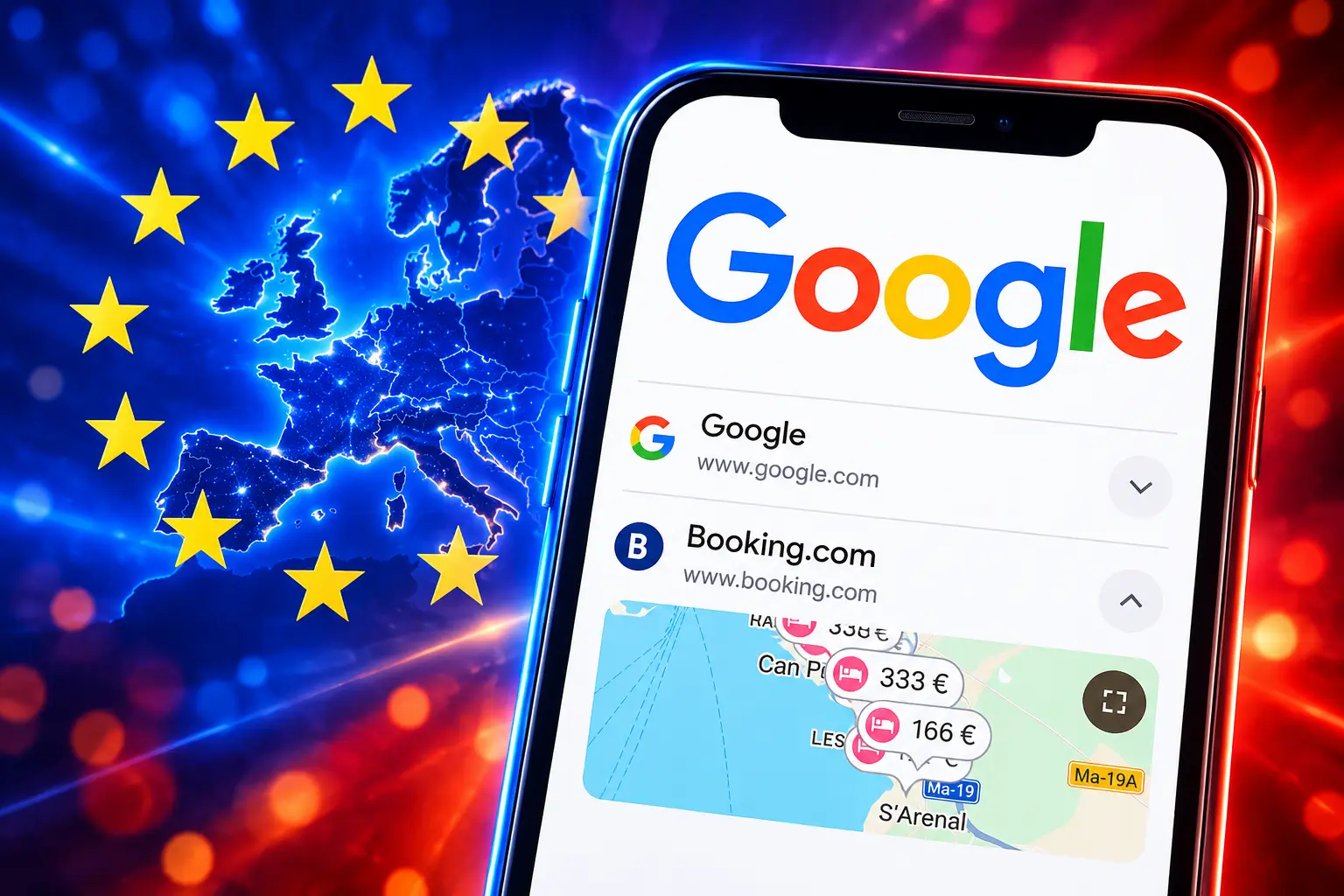
What a Hotel Query Looks Like Now
On a hotel, flight or restaurant query in the EEA, one specialised search engine sits at the top, two more follow with fewer details, and a carousel of hotels, airlines or restaurants sits below them. Fox said the layout boosts online intermediaries at the expense of local businesses and removes features people use every day. He added that users outside the EU are not affected. Google’s product docs are wider than that wording: the units are for the EEA, which also covers Norway, Iceland and Liechtenstein.
The company told press it had tested the design with millions of users in Europe and saw a high level of dissatisfaction, including people having to retype queries. An unnamed Google official called the package the largest drop in quality in Search’s 29-year history. That is Google’s own verdict, not a third-party audit.
WHAT THE SUPPLIER CAROUSEL LOST
- Live rates: Real-time hotel and flight prices are stripped from the supplier carousel.
- Instant availability: Whether a room or seat is free is no longer sitting on that card.
- The first tap: Clicks inside the expanded aggregator box go to the comparison site, so the hotel website is no longer the first structured destination.
The aggregator docs still tell those sites to keep pricing and availability up to date, and to send photos, ratings and categories. The rich, priced look did not leave the page. It moved into the box that comparison sites control. On the live mobile page, that is the module that now greets a generic hotel search. The hotel card under it reads more like a directory line.
Paid hotel ads are a separate surface. Those carousels can still show rates and deal labels, which makes the organic supplier box look even thinner next to the ad unit on the same results page.
July’s €890 Million Package Started a 60-Day Clock
The Search redesign is the product answer to a legal clock, not a seasonal refresh. On 23 July 2026 the Commission fined Google €460 million for self-preferencing on Search and a further €430 million over steering rules on Google Play, €890 million in two decisions. Search was the larger case. The finding was that Google gave its own shopping, hotel, transport and sports results better placement, including the top of the page and richer visuals and filters, while similar third-party services did not get the same treatment.
Gatekeepers may not treat their own services more favourably in ranking than third-party services, and they have to apply transparent, fair and non-discriminatory conditions. Google was told to bring the breach to an end and to treat third-party services that appear in its results fairly by reference to its own. Miss the 60-day window after 23 July and the file can move to periodic penalty payments of up to 5% of worldwide turnover. The Commission named no calendar day in the press release; the 8 September rollout landed inside that window.
THE DMA CLOCK ON GOOGLE SEARCH
- 6 September 2023: The Commission designates Alphabet as a gatekeeper, including Google Search.
- 7 March 2024: Full DMA duties apply to those designated services.
- 25 March 2024: The Commission opens non-compliance investigations into self-preferencing on Search and steering on Play.
- 19 March 2025: Google is told of a preliminary view that it is in breach.
- 23 July 2026: Two non-compliance decisions, €460 million and €430 million, with 60 days to comply.
- 8 September 2026: Aggregator and supplier units go live in EEA Search; the vacation rentals unit is removed.
Teresa Ribera, executive vice-president for a clean, just and competitive transition, said Google had fallen short of effective compliance. Henna Virkkunen, executive vice-president for tech sovereignty, security and democracy, said Google harms businesses offering similar services, such as shopping or sports, by withholding the same prominence. The “businesses” in that sentence are rival search services, not a family hotel with a three-page website. Google’s public line collapses those rivals and that hotel into one story about local firms.
The Commission said that after talks, Google had proposed and started testing changes for free services such as shopping, hotels and flights, and that those tests were substantial progress. It also took note of proposals for AI Overviews and AI Mode, and said that dialogue would continue. It has not published a sign-off on the September page.
Direct Booking Clicks Already Fell 30 Percent
This is the second major rewrite of European Search under the DMA, not the first. In a 26 November 2024 note, Oliver Bethell, then Google’s director of legal, wrote that the company had already made more than 20 product changes in Search, including dedicated units and chips so users could find comparison sites for flights, hotels and shopping, and that it had removed the Google Flights unit from the results page and reduced what some clickable maps could do.
Airlines, hotel operators and small retailers, he wrote, had reported that free direct booking clicks down as much as 30% since those original changes. Google repeated that figure when it announced the September layout, and said the new units would hit those businesses again. It is the company’s own compilation of what those firms reported, not an independent traffic study, and it describes the earlier wave, not a measured result from the 8 September page.
THE JULY PACKAGE IN FIGURES
- Search fine: €460 million ($534 million) for self-preferencing on shopping, hotels, transport and sports.
- Play fine: €430 million, issued the same day, over steering rules.
- Earlier traffic claim: Free direct booking clicks down as much as 30%, per Google’s 2024 note.
- Next stick: Periodic payments of up to 5% of worldwide turnover if the 60-day order is missed.
Comparison sites had kept asking for more, Bethell wrote, including in some cases a ban on anything richer than a blue link, which would have blocked prices and ratings on the page. Google ran a short test in Germany, Belgium and Estonia that pulled hotel maps and the results under them and showed a list of links instead. The September design is the opposite of that test in one respect: it still shows rich modules. It just hands the richest free module to the aggregators.
No Replacement Date for Vacation Rentals
Hotels at least got a second box. Vacation rentals did not. Hostaway, which pushes listings into Google Vacation Rentals, told hosts on 8 September that Google had removed that unit from the Search results page for EEA users as part of DMA compliance. Hosts may see fewer impressions, clicks and bookings from Google, it said, and listings can look missing to anyone testing Search from an EEA country.
The feed itself is not dead. Hostaway said Search still works as before outside the EEA, and that listings can still appear on Maps and on Google Travel. Google has not given a date for a replacement Search unit in the EEA, and Hostaway told hosts that no action on their side would bring the old box back.
That is a harsher outcome than the hotel layout. The DMA case was about equal treatment with Google’s own units. For vacation rentals, equal treatment arrived as deletion. Anyone searching for a cottage from an EEA IP now has to leave Search or go through an OTA to do the job the old unit did on the page.
Why the Hotel Card Cannot Appear Alone
The supplier unit is the box Google points to when it talks about local businesses. Direct providers, from hotels and airlines to brick-and-mortar shops and even plumbers, can appear there for the same query classes as the aggregator unit. The catch is written into the help page: the supplier unit only appears if the aggregator unit appears.
A hotel cannot win a dedicated Search unit on its own under this design. If Google does not show the comparison-site module, the supplier module stays off. The “direct” path is a companion to the intermediary path, not a replacement for it. Google’s Actions Center documentation describes the same two-unit model for dining, services and attractions, with no public launch date, so local queries may follow the same logic.
By 14 September a further EEA-only carousel was showing on weather, sports, finance and translation queries on desktop and mobile. Sports was one of the verticals in the July finding. The company is still redrawing more of the page than the hotel box that dominated the first day’s argument.
Fox said users outside the EU would not see these changes. That split is now a product fact: a search for the same Madrid hotel from Spain and from the United States no longer returns the same page. Anyone writing hotel SEO from a US screenshot is looking at the wrong machine.
Teresa Ribera Said Better Products Should Win
These changes degrade the user experience for Europeans
Nick Fox, Senior Vice-President of Knowledge and Information, Google
Fox’s full line also said the layout boosts online intermediaries at the expense of local businesses and removes features people rely on every day. Google is not hiding the politics. It wants European users and hotels angry at Brussels, not at Mountain View, and it put that ask in the same statement as the shipping notice.
The best products should succeed because they’re better, not because they’re owned by the company running the search engine.
Teresa Ribera, Executive Vice-President, European Commission, 23 July 2026
The Commission’s order was about rival search services getting the same shot as Google Hotels and Google Flights. The September page does that in a literal way: Booking-class sites now occupy the expanded, priced module, and Google’s own travel widgets no longer sit above them as a privileged layer. The hotel in Porto still appears, as a name, a site link and the address it has published for years, and only when the aggregator box is on screen. Live rates live with the intermediary.
Brussels says consumers should be free to use an intermediary or to go direct. Google says the direct route just got slower and that businesses will pay more to be found. Both statements can sit on the same results page. The Commission is still watching that page, and it still has periodic penalties if it decides the design falls short. Dialogue on how the same rules apply to AI Overviews and AI Mode has not closed.

Another IndiGo Radome Splits After a Normal Lucknow Landing

Apple Will Make Full Disk Access an Explicit Mac Grant

Chainalysis AI Traced the Bitget Hack in 10 Minutes

Yapily Sits Out Open Banking Deals After Turning a Profit

Google’s Gemini 4 Argon Goes to Cyber Defenders First

BMW’s Heated Seat Retreat Taught Automakers Which Fees Survive

Nashville Votes for a Dolly Parton Airport It Has Not Named

Copilot’s Election Problem Shifted From Errors to Silence

Tesla Burns AI Cash While SpaceX Sends the Invoices

The Book on China’s Car Brain Still Stars Infineon
-
 AUTO3 years ago
BMW’s Heated Seat Retreat Taught Automakers Which Fees Survive
-
 ENTERTAINMENT1 month ago
Nashville Votes for a Dolly Parton Airport It Has Not Named
-
 NEWS2 months ago
Tesla Burns AI Cash While SpaceX Sends the Invoices
-
 NEWS3 years ago
Copilot’s Election Problem Shifted From Errors to Silence
-
 NEWS2 months ago
The Book on China’s Car Brain Still Stars Infineon
-

 NEWS2 months ago
John Ternus Debuts a $2,099 Foldable and Holds iPhone 18
-

 ENTERTAINMENT2 months ago
Dolly Parton Laid to Rest as the Public Funeral Began
-

 TECHNOLOGY3 years ago
How to Find Saved Audio on Facebook?