
LIFESTYLE
When Was the First RC Car Made?
When was the first RC car made? The shop model dates to 1966, a full-size radio car ran in 1925, and radio control began with an 1898 boat, not a car.

Radio-controlled cars, usually called RC cars, are small vehicles you steer with a radio in your hands. When was the first RC car made? The honest answer is a set of dates, because that question covers more than one machine.
The first model a person could buy dates to 1966, when an Italian firm sold a Ferrari 250LM and an American firm showed a radio Mustang at a Chicago hobby show. A full-size radio car had already driven New York on July 27, 1925. The first radio-controlled device on record is a boat from 1898.
What follows matches each date to a real machine, then follows the path from that street run to the cars you can buy now. You get Ford’s studio models, the 1966 shop cars, the Tamiya kits, and the split between electric and nitro, on-road and off-road.
Which RC Car Date Matches Your Question?
Pick the picture you already have in mind, then read the date that belongs to it. A pool in New York, a Chandler in traffic, a Ferrari from a toy shop, and a Porsche kit from a hobby counter are four different firsts, and short guides often glue them into one year.
| What you mean | Date | The machine |
|---|---|---|
| Radio control itself | 1898 | Nikola Tesla’s radio-controlled boat |
| A full-size car on a public street | July 27, 1925 | American Wonder, a Chandler sedan in New York |
| A model car people could buy | 1966 | El-Gi Ferrari 250LM, with a Wen-Mac Mustang the same year |
| The scale electric car that spread the hobby | November 1976 | Tamiya’s 1/12 Porsche 934 Turbo |
The boat comes first in time, and it is the wrong machine if you came here for a car. The first radio-controlled device on record is the boat Tesla showed in 1898 at an electrical exhibition in Madison Square Garden. His patent for moving vessels or vehicles was granted on November 8, 1898, and the wording already covers a vehicle, even though the machine in the pool was a boat.
A full-size sedan with a chase car is one machine, a boxed model is another, and the electric kit that spread the hobby came later still. Keeping those apart is what makes the date useful.
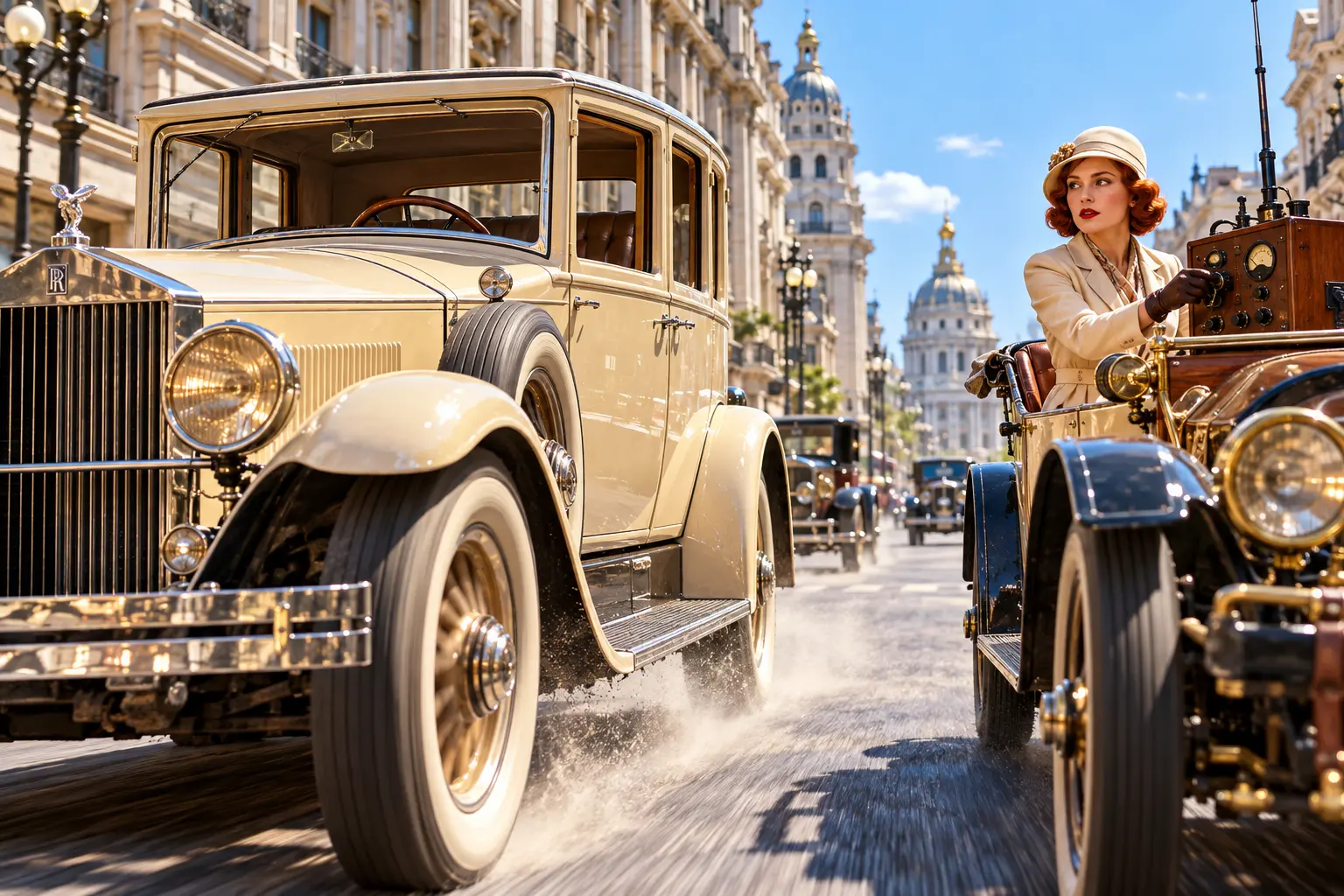
What Drove Itself Down Broadway in 1925?
Radio control was already decades old by the time a car used it in traffic. You can follow how that boat took its commands: a steel hull about four feet long, with the signal working a propeller, a rudder, and small running lights. The New York car put that idea on a street, with the operator in a second vehicle instead of beside a pool.
On July 27, 1925, a 1926 Chandler called the American Wonder drove up Broadway and down Fifth Avenue through thick traffic. Francis P. Houdina, an electrical engineer, fitted a receiving antenna over the rear seat and kept the transmitter in a car that followed. Radio signals ran small electric motors, and those motors worked the controls of the Chandler.
Accounts from the day say the car barely missed trucks, automobiles, and a milk wagon, then hit a sedan. A second New York run, on August 1, 1925, went out with a motorcycle police escort. In October 1925 the same radio-operated car was shown in Boston, so the Broadway trip was not a one-afternoon trick.
That Chandler answers a narrower question than most hobby pages ask. It is the earliest full-size car with a documented public radio run, and it needed a person in the car behind it. It does not explain the plastic model, the stick radio, or the buggy you see at a park.
What Did Ford Do With Radio Models in 1954?
The Chandler was a publicity run with a chase car. The next radio cars that left a paper trail were models inside Ford, used to judge real car shapes rather than to start a hobby.
In Ford’s Industrial Arts Awards, David Swinder of Warren, Ohio took third prize with a streamlined radio-controlled vehicle six feet long. He ran it from a large console for Al Esper, Ford’s chief test driver. That prize car is its own machine, not a studio prototype with a different name.
Ford’s studios used scale models for a plain reason: a driving model let designers judge a shape in less time, and for less money, than a full prototype. In January 1954 Alex Tremulis took over the Advanced Studio. With assistant Romeyn Hammond he built the LaTosca, a bubble-top dream car, as a 3/8-scale model that could move under its own power.
The running gear was about $1,000 of real car parts. A six-volt car battery fed the system, Lincoln convertible-top motors drove the wheels, a power-window regulator stood in as a transmission, a power-seat unit steered, and model-airplane radio gear sent the commands. Window relays tied the switches together.
Designers watched through binoculars as the LaTosca ran down Oakwood Boulevard, moved in and out of traffic, stopped for signals, and turned into the plant driveway. The radio still worked at a mile and a quarter.
A second studio shape, the Mexico, was a sleek reskin of the 1955 Thunderbird, drawn as a full-size idea meant to top 200 mph. Accounts of these studio models say the radio also ran headlights, brake lights, and turn signals. Swinder’s six-foot prize car and the LaTosca share a year, and they are still two projects: one a contest entry, one a tool on the design floor.
What Could You Buy in 1966?
Studio models were not a product on a shop shelf. The year hobby histories mean is 1966, and that year has two cars, not one inventor. If your picture is a model in a box, with a handset and a plastic body, this is the date to keep.
A few Americans were already running home-built radio cars that never reached a shop. Bill Johnson of Burbank had a test car in 1963 or 1964. Charles Eckles was running engine-powered cars on Mustang bodies by 1965. Norb Meyers, who later started Ra/Car Developments, built his in 1965 or 1966. Those were race specials. A buyer still had almost nothing to purchase.
The El-Gi Ferrari 250LM
Elettronica Giocattoli, known as El-Gi, put a 1/12 Ferrari 250LM on the market in Italy. The car magazine Quattroruote described that radio car in its June 1966 issue, so the model was already public that summer. A sales receipt that survives with one car is dated October 14, 1966, and the American hobby magazine Car Model listed it as a new product in January 1967.
WHAT THE 1966 FERRARI COULD DO
- Body: A plastic 1/12 Ferrari 250LM, about 30 centimeters long, with a hood that opens and a shell that comes apart so you can reach the works.
- Radio: Three channels and four keys, for power, stop or forward, left, and right, with a telescopic antenna on a small box.
- Speed: About 60 meters a minute on charged batteries, which the magazine states as 3.6 km/h.
- Power: Two 9-volt batteries for the radio system, and six 1.5-volt batteries for two motors, one to drive and one to steer.
- Range: 20 meters, after which the car holds the last command and drives on with nobody in charge.
- Price: 28,000 lire with the remote and without batteries.
Steering on that Ferrari depends on how long you hold the button. A short press moves the wheels a little, a long press winds them to full lock, and a circuit then stops the steering so you can let go. The magazine turns that walking pace into full-size terms and gets 43.2 km/h, then says a faster motor would only make the model harder to keep in one piece.
A Ferrari P4 from the same company followed in 1968. The 250LM remains the car with the earlier paper trail: a magazine story, a receipt, and a listing in the American hobby press.
The Wen-Mac Mustang in Chicago
The Ferrari is the car later writers name first, and it was not alone. A battery plastic 1/11 Ford Mustang from Wen-Mac, a tether-car maker that Testors bought in 1966, reached the Hobby Industry Trade Show in Chicago in February 1966 at $69.95. It used dual-motor proportional radio, so speed and steering could sit partway on, not only full left, full right, or full stop.
A February show date sits ahead of the June magazine story, so a single crown for first on sale does not sit cleanly on either car. The fair summary is that 1966 is the year model radio cars became products: a button-box Ferrari at a walking pace, and a proportional Mustang shown to the hobby trade. The off-road electric buggy most people picture now was still years away.
How Did Tamiya Kits Change RC Cars?
Electric cars and nitro cars then split the hobby. In the late 1960s, builders in Britain and the United States raced 1/8 pan cars, flat chassis with a model-airplane two-stroke in the back and a body shell on top. British makers such as Mardave joined the Italian and American firms. Those cars were fast, loud, and fussy, and they asked for a track more than a driveway.
Tamiya’s turn looked like a scale model that happened to drive. The company’s own timeline places the 1/12 scale Porsche 934 Turbo release in November 1976, and describes that car as the one that set off the RC car boom. The firm’s RC account marks December 4 as the day it celebrates that first electric car, which is a memorial date beside the November release, not a second launch month.
【12/4はタミヤ電動RCカーの日】1976年にタミヤ初の電動RCカー「ポルシェ ターボRSR 934レーシング」が登場❗️1/12プラモデルボディを採用した「走るスケールモデル」として大人気となりました。まさにタミヤRCカーの歴史はここから始まったのです🤩 #タミヤRC #tamiyarc pic.twitter.com/Birj59stLk
— Tamiya RC Models【タミヤ公式】 (@TAMIYAGP_STAFF) December 4, 2021
The Porsche mattered because the body was a real scale shape, taken from a static kit, on a chassis you were meant to drive. Shunsaku Tamiya had seen designer Fumito Taki running an electric conversion of a Tamiya F1 kit at lunch, and that hallway car pointed toward a product. Early cars in the line used ordinary dry cells, and the detailed body was too fragile for hard crashes, but the kit sold the idea that an RC car could look like the race car on the poster.
Dirt came next, on a date you can separate from the Porsche. In 1979 the Rough Rider, a 1/10 Tamiya buggy, took electric cars off the pavement. Team Associated’s RC10 arrived in 1984 at about 15 inches long, with an aluminum tub for a chassis, built for people who wanted to race and tune rather than only to park a body on a shelf. That buggy is the shape a lot of drivers still mean by RC car: a battery, suspension at each wheel, and a dirt lot.
Which RC Car Fits the Way You Drive?
The cars on sale now still use the split that opened after those kits. You choose a surface, a power source, and how much building you want before the first run.
| Choice | Best fit | Watch-out |
|---|---|---|
| On-road | Pavement, carpet, a smooth lot, or a track | Low cars and slick tires bog down in grass |
| Off-road | Dirt, gravel, and uneven ground | Big tires and long travel are a poor match for a parking-lot race |
| Electric | A first car, a backyard, or indoor practice | You need a charged battery and a speed control that feeds the motor |
| Nitro | Outdoor running and the sound of a small engine | The engine drinks a nitromethane blend and needs tuning |
| Ready to run | You want to drive the same day | You still add a battery or fuel, plus a charger or starter gear |
| Kit, or almost ready to run | You want to build the car and set it up | The first evening goes to assembly, not to driving |
Scales on the box tell you how a new car sits next to those early models. The El-Gi Ferrari and the Tamiya Porsche were both 1/12. The RC10 that set the off-road racing look was about 15 inches long, the size hobby shops now label 1/10. Larger 1/8 cars carry on the nitro pan-car line, and smaller 1/18 cars are the floor toys at the other end.
MINI 4WD CARS HAVE NO RADIO
- The mix-up: Tamiya’s Mini 4WD line is often filed beside RC cars in the same history, and it is a different toy.
- The first kits: The Ford Ranger 4×4 and the Chevrolet Pickup 4×4 went on sale on July 13, 1982.
- How they run: One motor, two AA batteries, no steering radio, and rollers that keep the car against a walled track.
Tamiya’s own archive treats radio-controlled models, on sale from 1976, and the Mini 4WD series as separate hits. A Mini 4WD is excellent on its track and useless as a date for the first radio car. If the car in your hand has no transmitter, you are holding the 1982 line, not the 1966 one.
For a first RC car, an electric ready-to-run model matches a common way to start: a battery, a charger, and the transmitter that comes in the box. Nitro carries on from the late-1960s engine cars, and it fits once you want a tuned engine and outdoor noise. A kit makes sense when the build is the fun, which is why the 1976 Porsche was sold as something you assembled.
Frequently Asked Questions
Was a Driver Hiding in the 1925 Radio Car?
A later story said so, and nothing from the New York runs proves it. In January 1927 a tale spread that a person hidden in the car was doing the driving, after Houdina left workers in Indianapolis unpaid. The 1925 runs were described as radio signals working small electric motors, with the operator in a following car. Treat the hidden-driver tale as gossip from a messy breakup, not as the account of the Broadway run.
Why Do Some Guides Date RC Cars to the 1940s?
Those guides use the postwar years as a blanket date, and they do not name a model. Radio had already been used on boats and aircraft, so the label covers years when no single car is named. For a date you can check, use the Chandler, the Ferrari, or the Porsche, each of which is a named machine.
Can Several RC Cars Run in the Same Park?
They can, as long as their radios are not fighting over one channel. Early hobby sets used a plug-in crystal, so two drivers on the same crystal would steer into each other or lose the car. A 2.4 GHz set takes a free channel when you switch it on, which is why a club can start a whole heat together. Electric cars and nitro cars can share that radio, because the transmitter does not care what turns the wheels.
Did El-Gi Sell the Ferrari Without a Radio?
Yes, the same Ferrari was also sold as a parts box with no transmitter, at 6,950 lire, for collectors who wanted the model rather than a car they could drive across a room. You could still fit batteries and spin the motors. Nothing in that box would steer it from a distance.
Picture the El-Gi Ferrari when you want the first RC car sold as a model. It was a 1/12 plastic body with a button box, and the radio let go after 20 meters. The Chicago Mustang, the Porsche kit, and the dirt buggy all followed that car.

Another IndiGo Radome Splits After a Normal Lucknow Landing

Apple Will Make Full Disk Access an Explicit Mac Grant

Chainalysis AI Traced the Bitget Hack in 10 Minutes

Yapily Sits Out Open Banking Deals After Turning a Profit

Google’s Gemini 4 Argon Goes to Cyber Defenders First

BMW’s Heated Seat Retreat Taught Automakers Which Fees Survive

Nashville Votes for a Dolly Parton Airport It Has Not Named

Tesla Burns AI Cash While SpaceX Sends the Invoices

Copilot’s Election Problem Shifted From Errors to Silence

How to Find Saved Audio on Facebook?
-
 AUTO3 years ago
BMW’s Heated Seat Retreat Taught Automakers Which Fees Survive
-
 ENTERTAINMENT2 months ago
Nashville Votes for a Dolly Parton Airport It Has Not Named
-
 NEWS2 months ago
Tesla Burns AI Cash While SpaceX Sends the Invoices
-
 NEWS3 years ago
Copilot’s Election Problem Shifted From Errors to Silence
-
 TECHNOLOGY3 years ago
How to Find Saved Audio on Facebook?
-
 NEWS2 months ago
John Ternus Debuts a $2,099 Foldable and Holds iPhone 18
-

 NEWS2 months ago
The Book on China’s Car Brain Still Stars Infineon
-

 LIFESTYLE3 years ago
How to Delete All Pins on Pinterest: One Board at a Time