
NEWS
Samsung Roasts Apple While Building the iPhone Duo Screen
Samsung roasted Apple’s iPhone Duo as leftovers, yet Samsung Display is the reported exclusive maker of the foldable OLED that makes the $1,999 phone possible.

Samsung spent Sept. 9 roasting Apple’s first foldable iPhone, then went back to building the screen that lets the iPhone Duo fold. The US Galaxy account called the $1,999 phone reheated leftovers while billboards in Seoul, Tokyo and London welcomed Apple to a category Samsung has led since 2019.
The jab is cheap. The panel is not. Korean industry officials say Samsung Display makes the custom foldable OLED the new iPhone cannot exist without, a supply line the mobile brand would rather you not notice while it sells the switch.
Samsung Needled Apple While the Keynote Was Still Running
The keynote was still rolling when Samsung Mobile US posted “So far, so same” and the hashtag #ItsTimeToSwitch. After Apple CEO John Ternus, in his first launch as chief, brought out the foldable, the same account went sharper.
Let us know when you're done reheating our leftovers 😉
— Samsung Mobile US (@SamsungMobileUS) September 9, 2026
That leftovers line is the one that travelled. Samsung had already posted a “Welcome to Foldables” video before the “Surprise and Shine” event, and it put up outdoor ads with “The World’s Lightest Fold” beside the welcome. Motorola piled on with its own copy-cat jab. Duolingo got dragged in as a punchline about the Duo name.
THE LINES SAMSUNG RAN
- Before the reveal: A “Welcome to Foldables” clip pushed the Galaxy Z Fold 8 as the world’s lightest fold, hours before Ternus spoke.
- During the Pro segment: “So far, so same,” aimed at an iPhone 18 Pro refresh that raised the floor price and left the standard model off stage.
- After Duo appeared: “Let us know when you’re done reheating our leftovers,” plus a crack about folding three ways while Apple made the room wait.
The jokes treat Apple as a tourist. Ben Wood, chief analyst at CCS Insight, put the timing the other way around: Apple is good at walking in once a product has matured. Samsung learned that the hard way. It shipped the first Galaxy Fold in 2019, pulled and delayed units after screens failed in reviewers’ hands, and has now put eight generations on sale. The eighth, the passport-style Galaxy Z Fold 8, arrived on July 22 at $1,899 and went on sale Aug. 7, less than two months before Duo’s unveiling.
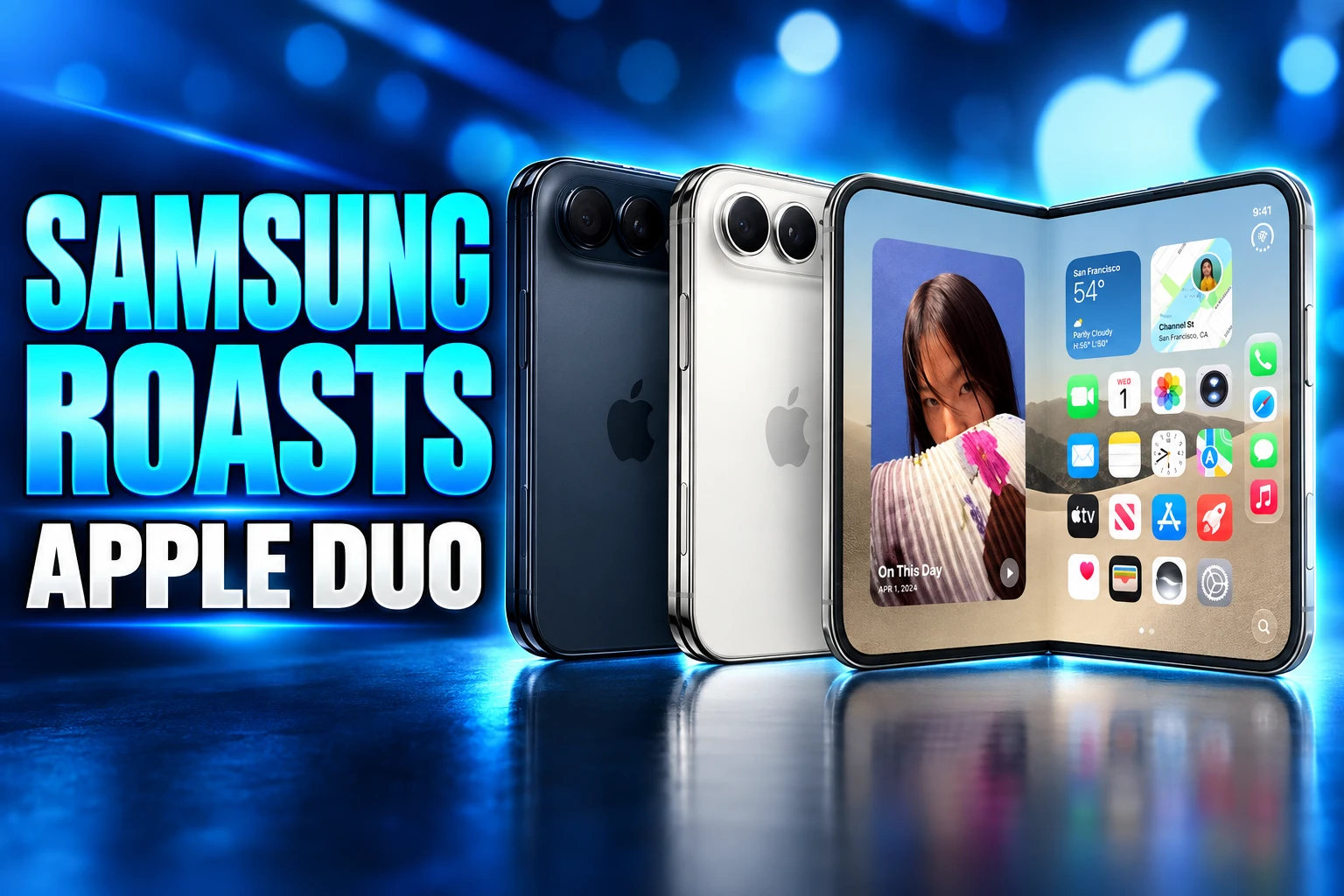
What Apple Put Inside the First Foldable iPhone
Ternus called the device the most transformational change to iPhone since the original. Closed, Apple says it is about the size of a passport, with a 5.4-inch outer Super Retina XDR panel that covers 90% of the screen area of iPhone 18 Pro. Open, the 7.6-inch inner panel is the largest display ever on iPhone, 50% larger than iPhone 18 Pro Max, and the body is 5.2 mm thick, which Apple calls its thinnest iPhone.
Both screens share one aspect ratio, ProMotion, Always On, and 3,000 nits of peak outdoor brightness. A nano-texture polymer on the inner sheet is up to 40% stiffer than materials Apple says the rest of the industry uses, and high-strength glass sits above and below the folding panel with adhesives meant to slide like pages in a book. A titanium plate sits under that stack. The hinge has more than 100 parts and a magnet array for a firm close. The frame is grade 5 titanium. Ceramic Shield covers the back; Ceramic Shield 2 on the front is rated for 3x the scratch resistance of the prior generation. The phone is IP68.
Power comes from A20 Pro, the same chip as iPhone 18 Pro, with a vapor chamber and batteries in both halves. Apple rates video playback at 31 hours on the inner display, 44 hours on the outer, and 24 hours if you use both evenly. Cameras are a 48MP Fusion main with 2x optical-quality telephoto and a 48MP Fusion Ultra Wide, the same ultra-wide as the Pro phones. There is no third rear lens. Face ID is gone; Touch ID sits in the side button. An under-display FaceTime camera hides in the inner sheet. Colors are star white and night sky. Storage starts at 256GB for $1,999, then $2,199 for 512GB, and $3,199 for 2TB. Pre-orders open Oct. 16. Units go on sale Oct. 23.
Ternus also needled the rest of the category, describing rival foldables as feeling like two phones stuck together. That is the line Samsung answered with leftovers. Hardware still has to clear a different test, because Duo is heavier and thicker than the Fold 8 it is priced against, and it drops pieces people already pay Pro money for.
IPHONE DUO VS GALAXY Z FOLD 8
| Spec | iPhone Duo | Galaxy Z Fold 8 |
|---|---|---|
| Starting price (256GB) | $1,999 | $1,899 |
| Weight | 254 g | 201 g |
| Thickness, open | 5.2 mm | 4.5 mm |
| Thickness, folded | 11.3 mm | 9.7 mm |
| Inner display | 7.6-inch | 7.6-inch |
| Cover display | 5.4-inch | 5.5-inch |
| Availability | Oct. 23, 2026 | On sale since Aug. 7, 2026 |
The $100 gap is the pricing trick Liz Lee, an associate director at Counterpoint Research, called one of the most impressive parts of the launch, because it parks Duo just under $2,000 and only a step above Samsung’s current book-style fold. iPhone 18 Pro starts at $1,199, so Duo asks $800 more for the hinge. Apple Pencil support over USB-C is promised later this year, not on day one.
WHAT DUO LEAVES OFF A PRO IPHONE
- Face ID: Unlock is Touch ID in the side button, with Apple Watch as a backup.
- The third camera: Two 48MP rear sensors, no dedicated telephoto module like the Pro trio.
- A matching standard iPhone: No iPhone 18 beside it this fall, so the expensive new shape has the stage to itself.
A Korean telecom official, speaking after the event, put the consumer question in one line: if you pay around $2,000 and lose things people associate with a flagship, they will ask how this is better. Apple’s answer is software poses, Split View, under-display video, and a crease it says will not grow. Reviewer Marques Brownlee, after handling the unit, said it had “the least crease I’ve ever seen on a folding phone” and that the crease was “definitely not gone.” Fold 8 owners spent Sept. 10 cloning the Duo keynote animation on a phone that has been in stores since August. The argument on the timeline is no longer whether Apple showed up. It is whether the first unit looks flatter at the spine than Samsung’s eighth.
The Fold in iPhone Duo Is a Samsung Display Job
That spine is the hidden invoice. Apple did not name its panel maker on stage. Korean industry officials and trade reports this year described Samsung Display as the exclusive supplier of the foldable OLEDs for as long as three years, building the sheets to Apple’s spec rather than handing over a Galaxy part. Reuters, in its account of the roast, also noted that Apple is using foldable screens from Samsung Display, the panel unit inside the same group now trolling iPhone buyers.
With the iPhone X, Samsung’s OLED was a component that made the iPhone look better. This time is different. Without the foldable panel from Samsung Display, the form factor itself simply cannot exist.
Korean display industry official
The iPhone X parallel is the one Seoul keeps reaching for. In 2017 Samsung Display was Apple’s exclusive OLED source for the first all-screen iPhone. Officials now say this is tighter, because the part is the product. Linda Sui, founder of Smart Analytics Global and a former TechInsights mobile-markets head, said other makers can produce foldable OLEDs, but matching Apple on quality, yield and millions of units is a higher bar, and Korea holds several hard-to-replace pieces of this phone, memory included.
Apple spent years spreading iPhone display work across Samsung Display, LG Display and China’s BOE. Leaving a first-generation foldable on one vendor is the tell. “Apple normally puts a lot of importance on diversifying suppliers,” the same Korean official said. “If it still decided to leave the most important component of a first-generation product with one company, that tells you the alternative isn’t easy right now.”
Samsung Electronics can mock leftovers on a US account while Samsung Display books the panel revenue from every Duo that clears the line. Those are different P&Ls that share a brand. The roast costs nothing. A three-year exclusive, if the trade reports hold, is a volume floor for a factory that has been folding OLEDs since 2019 and already builds the Galaxy Z series. Apple still designs the hinge, the iOS 27 layout, the vapor chamber and the camera stack. It does not, on this reporting, own the sheet that bends.
Counterpoint Puts Apple in Second Place This Year
The reason the joke has an edge is the forecast sitting under it. Counterpoint’s Aug. 2026 update, published Sept. 7, says lifetime foldable shipments will pass 100 million cumulative foldable shipments by the end of 2026, eight years after the first commercial fold. The category is still about 2% of global smartphone shipments, and prices remain about 3x a slab phone, so it is a premium niche, not a mass market. Apple is forecast to walk into that niche at scale anyway.
COUNTERPOINT’S 2026 FOLDABLE SHARE
- Samsung 38%: Still first, after eight generations and a July redesign of the book-style Fold.
- Apple 25%: Up to 6 million foldable iPhones in a short, supply-limited window, enough for second place.
- Huawei 22%: Third, still the China heavyweight, slightly behind Apple’s debut share.
- 2027: Apple’s shipments more than double and its share is forecast at 40%, with the whole category up 37%.
Liz Lee said initial supply will keep the 2026 ceiling at 6 million and that Samsung will see the most visible share pressure, with scale and distribution as the remaining defenses. Research director Tarun Pathak said Apple will raise competition at the premium end and that the category still has room because it is a sliver of the phone market. Xiaomi, Motorola, HONOR, Google, vivo and OPPO are all in the same forecast as brands prepping wider book-style models.
Samsung is not waiting for that math to land. A Samsung Electronics spokesperson said the share of iOS users moving to the Galaxy Z Fold 8 series was 1.6 times the prior Fold and Flip generation, and that in the US, 30% of Galaxy Z Flip 8 buyers came from other brands, most of them on a first foldable. That is the actual conversion campaign. The leftovers post is the loud wrapper.
The 53-Gram Gap Samsung Put on Billboards
Weight is the number Samsung chose for the street. The Fold 8’s 201 g Galaxy Z Fold 8 specs make it 53 g lighter than Duo’s 254 g, and 0.7 mm thinner when open (4.5 mm against 5.2 mm). Folded, Samsung is 9.7 mm against Apple’s 11.3 mm. Both inner screens are 7.6 inches. Samsung’s cover panel is listed at 5.5 inches on the full rectangle, 5.4 inches with rounded corners; Apple’s cover is 5.4 inches. The hardware argument Seoul wants is simple: eight years of reducing mass, and Apple’s first unit is the heavier passport.
Hands-on clips from Sept. 10 cut the other way on the crease. If Brownlee’s first look holds up in reviews, Apple’s opening night looks flatter at the fold than a product Samsung has been sanding since 2019. That is a bad week for a leftovers joke, because the leftover, in this telling, is the visible spine. Battery ratings also fail to help the roast: Apple’s 31 and 44 hours of video sit well above the Fold 8’s listed 26 hours of wireless video playback, even if lab tests later compress both claims.
Samsung can win the pocket and still lose the window display. Duo is already the object people photograph. The Fold 8 is the object Samsung needs iPhone owners to try before Oct. 16, which is why the US account kept posting through the keynote instead of waiting for reviews. The conversion stats on Fold 8 and Flip 8 are the serious half of that effort. The meme is the half that does not mention who laminates Apple’s inner sheet.
Why Apple Skipped a Standard iPhone 18 This Fall
The foldable is only half of the Sept. 9 surprise. Apple showed iPhone 18 Pro, iPhone 18 Pro Max and iPhone Duo, and it did not show a standard iPhone 18. That is the first time since Pro models joined the fall lineup in 2019 that the expensive phones have taken the stage without a cheaper new iPhone beside them. iPhone 18 Pro starts at $1,199, $100 above last year’s Pro floor, and Apple lifted leftover iPhone 17 prices by $100 after the event. Memory costs are the reason executives have already given for hardware inflation this year.
THE FALL 2026 IPHONE SPLIT
- 2019: Apple begins shipping Pro models each fall next to a new standard iPhone, a pairing that held through iPhone 17.
- July 22, 2026: Samsung unveils the passport-style Galaxy Z Fold 8 at $1,899, resetting the book-fold shape Apple then adopted.
- Sept. 9, 2026: Apple unveils iPhone 18 Pro, iPhone 18 Pro Max and iPhone Duo. No standard iPhone 18. Samsung posts the leftovers line.
- Oct. 16, 2026: iPhone Duo pre-orders open at 5 a.m. PT.
- Oct. 23, 2026: iPhone Duo goes on sale, with a second wave of countries on Oct. 30.
Analysts have been describing a spring slot for the cheaper iPhones, including a standard 18, an 18e and another Air, for months. Apple did not confirm that calendar on stage. What it did confirm is a fall devoted to the high end, with a foldable that starts at $1,999 sitting where a $799 iPhone used to share oxygen. For Samsung, that vacuum is a selling window. For Samsung Display, it is a production ramp that Counterpoint already calls supply-constrained.
The roast will be forgotten by the time those pre-orders open. The panel deal will not. Apple takes Duo orders on Oct. 16, and the sheets those phones need are, on every Korean account of the line, already moving through Samsung Display.
Frequently Asked Questions
How much does the iPhone Duo cost if you spread the payments?
Apple lists the 256GB model at $83.29 a month for 24 months, and Apple Upgrade through Klarna starts as low as $57.99 a month for 24 months for eligible US buyers. Those monthly figures sit on top of the $1,999 cash price and were not the headline number on stage.
Is the iPhone Duo eSIM only?
Yes. Apple is selling iPhone Duo as an eSIM-only phone, the same arrangement it used on last year’s iPhone Air, so there is no physical SIM tray. Carrier-connected units from AT&T, T-Mobile or Verizon are set to arrive ready to activate if you authorize that during checkout.
Does the iPhone Duo support Apple Pencil on launch day?
No. Apple said iPhone Duo will support Apple Pencil with USB-C later this year in a software update, on either display, for notes, sketches and markups. Launch units will not have that stylus path on Oct. 23.
Which countries get iPhone Duo first?
Apple said customers in more than 70 countries and regions, including the US, UK, China, India, Japan, South Korea and Germany, can pre-order from 5 a.m. PT on Oct. 16, with availability on Oct. 23. A further 28 countries and regions follow on Oct. 30.
Can you unlock iPhone Duo without Touch ID?
You can unlock it with Apple Watch, which Apple listed as a parallel path to the side-button Touch ID sensor. Face ID is not on the device; the inner FaceTime camera sits under the folding display and is for video, not the old TrueDepth unlock.

Another IndiGo Radome Splits After a Normal Lucknow Landing

Apple Will Make Full Disk Access an Explicit Mac Grant

Chainalysis AI Traced the Bitget Hack in 10 Minutes

Yapily Sits Out Open Banking Deals After Turning a Profit

Google’s Gemini 4 Argon Goes to Cyber Defenders First

BMW’s Heated Seat Retreat Taught Automakers Which Fees Survive

Nashville Votes for a Dolly Parton Airport It Has Not Named

Copilot’s Election Problem Shifted From Errors to Silence

Tesla Burns AI Cash While SpaceX Sends the Invoices

John Ternus Debuts a $2,099 Foldable and Holds iPhone 18
-
 AUTO3 years ago
BMW’s Heated Seat Retreat Taught Automakers Which Fees Survive
-
 ENTERTAINMENT1 month ago
Nashville Votes for a Dolly Parton Airport It Has Not Named
-
 NEWS3 years ago
Copilot’s Election Problem Shifted From Errors to Silence
-
 NEWS1 month ago
Tesla Burns AI Cash While SpaceX Sends the Invoices
-
 NEWS1 month ago
John Ternus Debuts a $2,099 Foldable and Holds iPhone 18
-

 NEWS1 month ago
The Book on China’s Car Brain Still Stars Infineon
-

 ENTERTAINMENT2 months ago
Dolly Parton Laid to Rest as the Public Funeral Began
-

 TECHNOLOGY3 years ago
How to Find Saved Audio on Facebook?